

Finance teams spend considerable effort preventing payment errors. Controls get tightened, approval workflows get added, and three-way matching gets stricter. All of that stops future problems. None of it recovers the money already paid incorrectly.
The reality is that your AP ledger contains errors. Duplicate payments, miscalculated freight charges, missed early-payment discounts, incorrect tax, unapplied credit memos—these accumulate over time despite strong controls. Standard month-end reconciliation catches current-period issues but does not flag historical ones. Once a payment clears and the period closes, that transaction rarely gets examined again.
Why historical AP holds recoverable value

Organizations with $50 million or more in annual AP spend typically process tens of thousands of invoices. Even with a low error rate, the absolute number of incorrect payments adds up. A 0.5% error rate across $75 million in spend creates $375,000 in recoverable overpayments. Most organizations have higher rates than that.
Common sources of overpayment include:
- Duplicate invoice payments when the same invoice enters the system twice under different numbers
- Freight and shipping charges that exceed contract rates or get billed twice
- Sales tax applied incorrectly to tax-exempt purchases
- Early-payment discounts not taken when invoices were paid within the discount window
- Price variances where billed rates exceed contracted rates
- Credit memos issued but never applied to the vendor account
- Quantity or unit-of-measure errors that inflate invoice totals
These errors have one thing in common: they are extremely difficult to spot through normal AP processes. Your team is focused on current invoices, vendor inquiries, and period close. No one has time to audit five years of payment history line by line.
The limitations of internal recovery efforts

Some finance teams attempt to recover overpayments internally. The effort rarely succeeds at scale. Running meaningful queries across large ERP datasets requires specific technical skills. SAP, Oracle, and JD Edwards each have their own data structures, and pulling transaction-level detail across multiple years is not straightforward.
Even with the data extracted, analysis is time-consuming. You need to identify patterns, match payments to invoices, cross-reference credit memos, and validate each potential recovery against source documents. Then comes vendor outreach, credit negotiation, documentation, and follow-up. For organizations with hundreds of vendors, the workload becomes unmanageable.
Most internal recovery projects stall after a few obvious duplicates get found. The deeper, more valuable errors remain buried.
How systematic recovery works
Effective overpayment recovery is forensic work. It requires pulling and analyzing complete payment history, applying algorithms that flag anomalies, and then validating each potential error against contracts, purchase orders, and receiving records.
Specialized firms use automated tools to analyze millions of transaction lines. The analysis identifies duplicate payments by comparing invoice numbers, amounts, dates, and vendor details. It flags tax charges on exempt items by matching tax codes to GL accounts. It catches missed discounts by comparing payment dates to invoice terms. It finds pricing variances by testing billed rates against contract tables.
Once potential overpayments are identified, the recovery process begins. Each error gets documented with supporting evidence. Vendors are contacted with clear, professional requests for credit. Disputes are managed through established vendor channels. Credits are tracked until they are applied or refunded.
The contingency model and zero upfront cost
The reason most CFOs have not pursued historical recovery is perceived cost and risk. Allocating budget and internal resources to a project with uncertain returns is difficult to justify. That is why contingency-based recovery makes sense.
Under a contingency model, the recovery firm performs the entire analysis, vendor outreach, and recovery process at no upfront cost. Fees are a percentage of actual cash recovered. If nothing is found, you pay nothing. The firm absorbs the risk and the workload.
For finance teams, this means negligible time investment. You provide data access, review findings, and approve recovery actions. The heavy lifting—data extraction, error identification, vendor communication, credit tracking—is handled externally.
What to expect from a recovery engagement
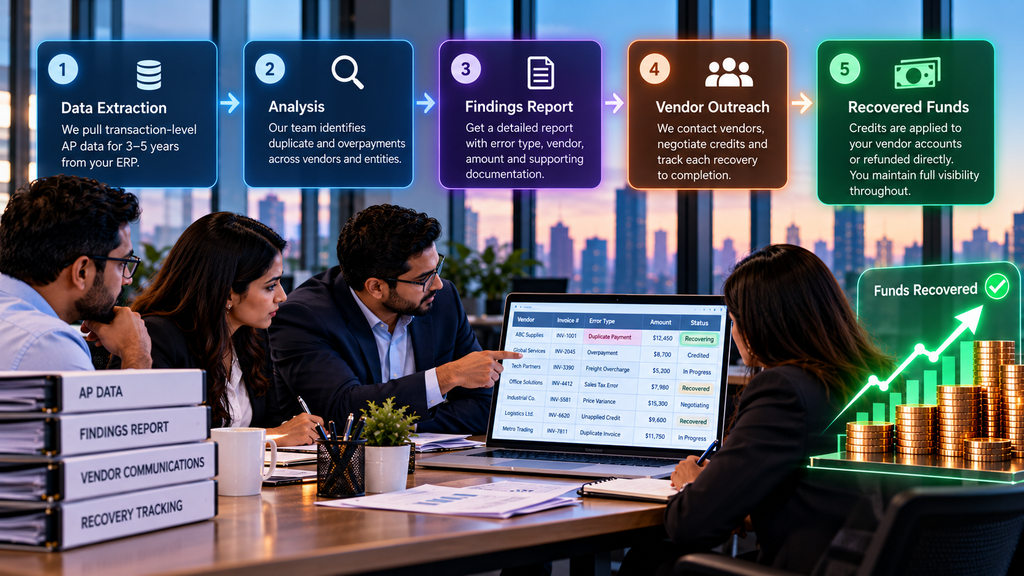
A typical engagement begins with data extraction. The firm pulls transaction-level AP data for the agreed lookback period, usually three to five years. Analysis takes several weeks depending on data volume.
You receive a findings report that details each recoverable overpayment, the error type, the vendor, and the documentation supporting recovery. You review and approve the items to pursue. The firm then contacts vendors, negotiates credits, and tracks each recovery to completion.
Throughout the process, you maintain full visibility. No vendor contact happens without your approval. All communications are professional and documented. Recovered funds are credited to your vendor accounts or refunded directly, depending on the arrangement.
When recovery makes sense
Organizations with high AP transaction volumes, large vendor bases, or complex procurement processes tend to have the most recoverable value. Companies that have gone through ERP migrations, merged with other entities, or experienced rapid growth often have higher error rates.
If your AP spend exceeds $50 million annually, a recovery analysis will almost certainly identify recoverable funds. The question is not whether errors exist, but whether the effort to recover them is worth the return. With a contingency model, that decision becomes simple: there is no downside to running the diagnostic.
Fintralis works exclusively with mid-market and enterprise finance teams on a 100% contingency basis, analyzing AP history across SAP, Oracle, and JD Edwards to recover overpayments with no upfront cost or internal resource drain. If your AP ledger holds recoverable cash, we find it and bring it back.
Frequently asked questions
What types of overpayments can be recovered from historical AP data?
Duplicate payments, calculation errors, incorrect tax charges, missed early-payment discounts, freight overcharges, unapplied credit memos, and pricing discrepancies are the most common. These typically accumulate over years because standard reconciliation processes don’t flag them retroactively. The recoverable amounts range from a few hundred to tens of thousands per line item depending on invoice size and error type.
How far back can you recover AP overpayments?
That depends on your vendor contracts and the nature of the error. Duplicate payments and clear calculation mistakes can often be recovered several years back. Pricing disputes and missed discounts have shorter windows. Most recovery work focuses on the past three to five years where documentation is intact and vendor relationships are active.
Does AP overpayment recovery create audit risk?
No, if handled correctly. Recovery work documents errors that already exist in your ledger. Properly conducted recovery actually reduces risk by correcting inaccuracies and strengthening vendor account reconciliation. The key is maintaining full audit trails and working only with documented discrepancies that vendors can verify.
How much time does AP overpayment recovery take from the finance team?
A contingency-based service requires almost no internal time. The recovery firm does the data analysis, vendor contact, and documentation. Your AP team reviews findings and approves recovery actions. Most finance teams spend fewer than five hours across the entire engagement. Self-directed recovery takes considerably longer and requires forensic AP expertise most teams don’t have in-house.
What is the typical recovery percentage from historical AP data?
Results vary by company size, AP volume, ERP system, and control environment. Organizations with high transaction volumes, complex supplier networks, or recent system migrations tend to have higher recovery rates. The analysis is zero-cost on a contingency model, so there is no downside to running the diagnostic.
Can overpayment recovery damage vendor relationships?
Not when approached professionally. Vendors expect and respect requests to correct billing errors. Most have processes for handling credit requests. The risk comes from aggressive or poorly documented claims. Working with a specialized firm that understands vendor communication and has established protocols minimizes any relationship friction.