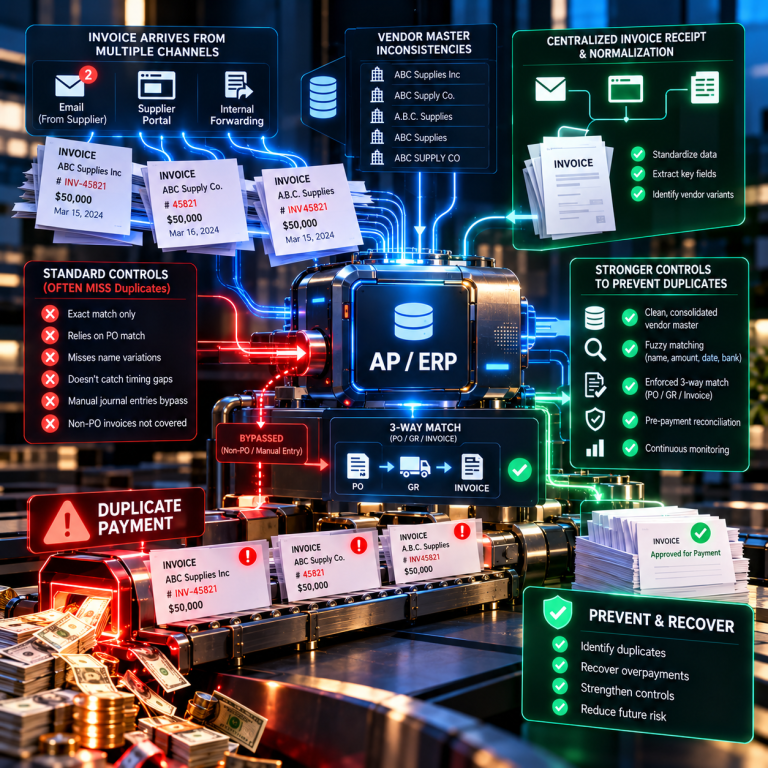

Most finance teams lack the spare capacity to run a forensic accounts payable review. The question is whether you should build that capability or hand it to a specialist on contingency.
The answer depends on team size, ERP complexity, and how much friction you can tolerate with suppliers.
When In-House Makes Sense
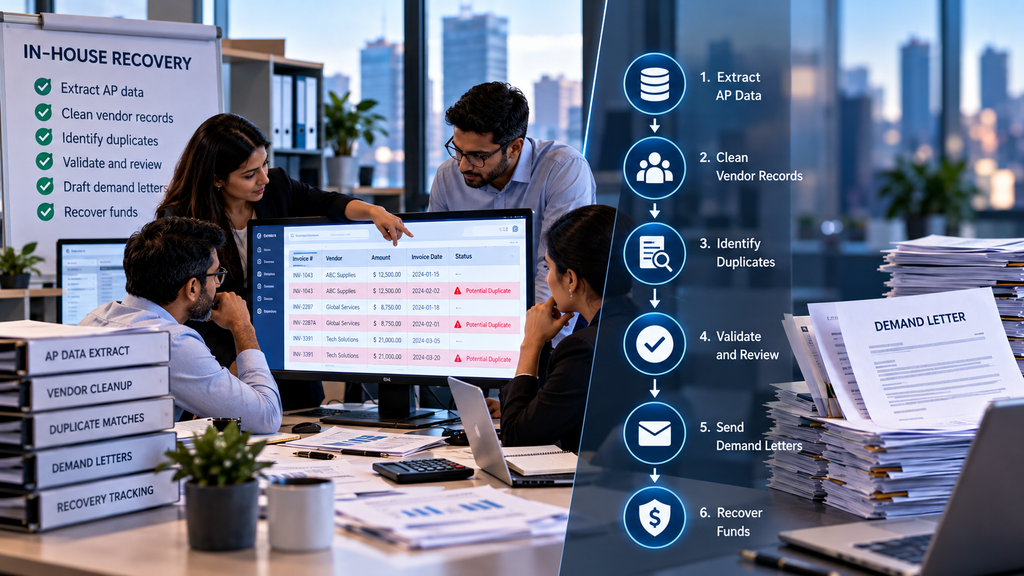
If your finance function includes ten or more FTE and you already have someone trained in ERP audit trails, you can probably run a duplicate payment sweep internally. The work requires extracting transaction data, cleaning vendor master records, matching invoices across entities, and writing queries that flag duplicate payments without false positives.
You also need someone willing to draft demand letters, negotiate with suppliers, and escalate to collections or legal counsel when a vendor disputes the claim. That takes time away from close, reporting, and cash management.
In-house recovery makes the most sense when you have dedicated headcount for process improvement, when your ERP instance is simple and well-documented, and when you want full control over supplier communication. It also works if you intend to run recovery sweeps on a regular cadence—quarterly or annually—so you can justify the fixed cost of building the capability.
When Outsourcing Makes More Sense

If your team is lean, if you run SAP or Oracle with multi-entity structures and custom workflows, or if you have no appetite for supplier disputes, outsourcing is the more practical choice.
A contingency-based recovery service absorbs the cost of data extraction, analysis, dispute management, and collections. You pay nothing upfront and nothing if the service recovers nothing. The fee comes out of funds you would not have recovered on your own.
Outsourcing also removes the distraction. Your team does not spend weeks learning ERP audit techniques, writing SQL queries, or negotiating with vendors who insist they were paid correctly. The service handles the entire process, from data pull to final cheque.
ERP Complexity
SAP, Oracle, and JD Edwards generate millions of transaction records. Vendor master data is inconsistent. Invoice references change between PO, goods receipt, and payment. A single duplicate can span three fiscal years and two legal entities.
Identifying duplicates in this environment requires deep system knowledge and forensic technique. Most finance teams do not maintain that expertise because they do not need it for day-to-day work. Outsourcing gives you access to specialists who work inside these ERPs every day and know where duplicates hide.
Supplier Relationship Risk
When you tell a supplier they were overpaid, the first response is usually denial. The second is a request for documentation. The third, if you press hard enough, may be a legal letter.
Handling that internally means your AP or FP&A team becomes the face of the dispute. If the relationship is strategic, that can create friction. If the supplier refuses to pay, you need to decide whether to write it off or escalate to collections.
A third-party service absorbs that friction. Suppliers know the claim is coming from a specialist, not from the finance team they work with every day. Disputes are handled at arm’s length, and your internal relationships stay intact.
Cost Comparison
Contingency fees typically sit between 15 and 25 percent of recovered funds. If you recover half a million dollars, you pay $75,000 to $125,000, and only if the recovery happens.
Building in-house capability means a fully-loaded FTE salary, ERP audit software or custom reporting tools, and legal or collections support when needed. That can exceed $150,000 a year, whether you recover anything or not.
The choice hinges on whether you have sustained volume. If you run a one-time sweep, contingency makes sense. If you plan to audit AP every quarter and have the team to support it, in-house may be cheaper over time.
When Hybrid Models Work
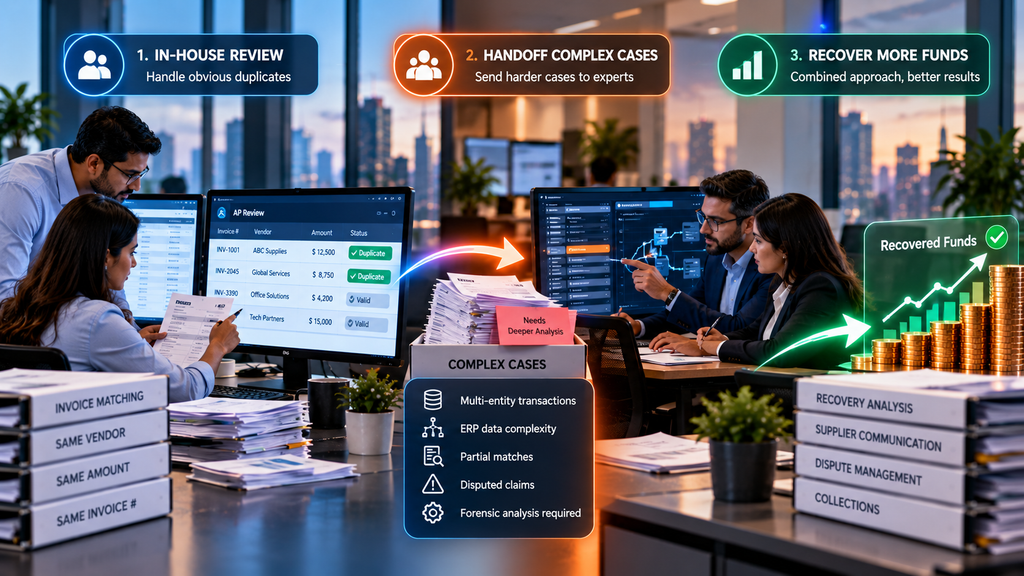
Some companies run a light internal review first, then hand the harder cases to a contingency service. That lets your team recover obvious duplicates—exact invoice matches paid twice in the same month—while outsourcing the complex forensic work.
The downside is coordination. You need to define clear handoff criteria so the service does not re-analyze transactions your team already cleared. You also need to decide how to split recoveries if a claim spans both internal and external work.
Hybrid models work best when you have a process-improvement analyst who can dedicate a few hours a month to AP hygiene, but not enough bandwidth to run a full recovery programme.
Decision Framework
Ask three questions. First, do you have 10 or more finance FTE and someone trained in ERP audit trails? If no, outsource. Second, are you running SAP, Oracle, or JD Edwards with multi-entity complexity? If yes, outsource. Third, do you want to handle supplier disputes and potential litigation internally? If no, outsource.
If you answered yes to all three, you can probably build the capability in-house. If you answered no to any of them, contingency-based recovery is faster, cheaper, and lower-risk.
Fintralis runs duplicate payment recovery across SAP, Oracle, and JD Edwards on a 100 percent contingency basis. You pay nothing unless we recover funds. If your AP spend exceeds $50 million and you want a no-risk audit, we can help.
Frequently asked questions
When should a company outsource duplicate payment recovery instead of doing it in-house?
Outsource when your finance team has fewer than 10 FTE, when you lack ERP audit-trail expertise, or when you want zero upfront cost. In-house makes sense when you have dedicated headcount, deep system knowledge, and appetite to manage vendor disputes and potential litigation without external support.
What are the main costs of building an in-house duplicate payment recovery team?
The main costs are dedicated FTE salary and benefits, ERP audit software licenses or custom reporting tools, training on forensic AP analysis, and legal or collections resources if vendors dispute repayment. Most finance teams cannot justify these costs unless recovery becomes a recurring, high-volume activity.
How does ERP complexity affect the decision to outsource duplicate payment recovery?
Complex ERPs like SAP, Oracle, and JD Edwards generate millions of transaction records with non-standard vendor master data, multi-entity structures, and custom workflows. Extracting duplicates requires deep system knowledge and audit-trail expertise that most finance teams don’t maintain, making outsourcing more efficient than building that capability internally.
What risks come with handling duplicate payment recovery in-house?
In-house recovery exposes your team to vendor relationship friction, dispute escalation, and potential litigation if a supplier refuses repayment. Your staff must draft demand letters, negotiate settlements, and sometimes coordinate with legal counsel—all of which distracts from core finance work and can strain supplier partnerships if handled poorly.
Does a contingency-based recovery service cost more than hiring internally?
Contingency fees typically range from 15 to 25 percent of recovered funds, paid only on success. For a company recovering $500,000, that means $75,000 to $125,000 in fees. Hiring internally costs a fully-loaded FTE salary plus software and legal support, often exceeding $150,000 annually whether you recover anything or not.
What size of AP spend justifies outsourcing duplicate payment recovery?
Companies with annual AP spend above $50 million typically have enough transaction volume to generate recoverable duplicates. Below that threshold, recovery amounts may not justify even a contingency engagement. Above $200 million, the complexity and volume often make outsourcing more practical than dedicating internal headcount.