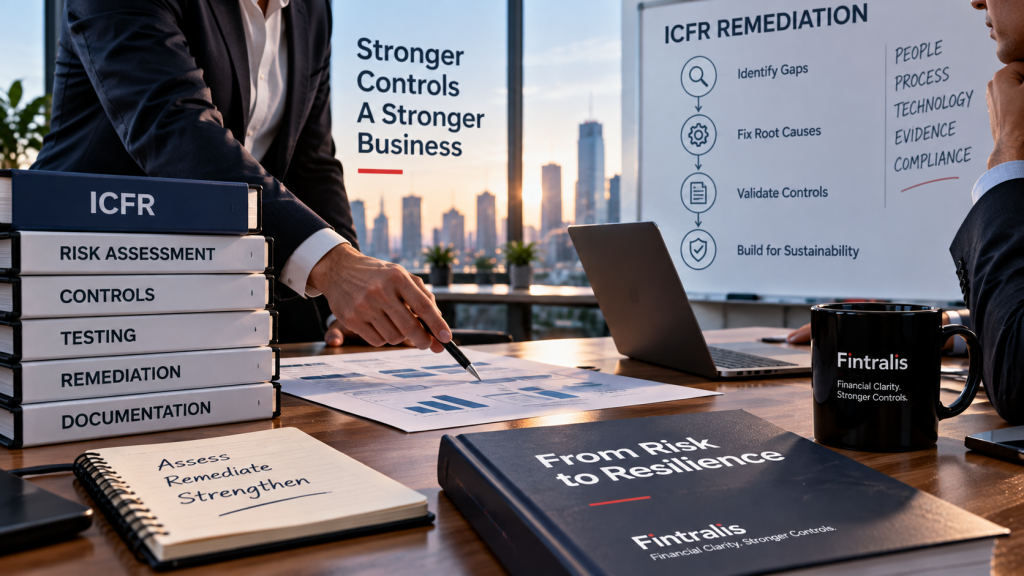
ICFR remediation is what happens when the controls that ensure accurate financial reporting break down. You discover a deficiency, determine what failed, fix it, prove the fix works, and document everything for your auditors. It is time-consuming, it disrupts close calendars, and it cannot be avoided once a weakness is identified.
Here is what the process actually looks like, why it matters, and how it connects to accounts payable recovery.
What ICFR Remediation Involves

Internal controls over financial reporting exist to prevent or detect material misstatements before they reach your financials. When one fails—or never existed—you have a deficiency. Remediation is the structured process of fixing it.
The steps are consistent across most frameworks:
- Identify and classify the deficiency as a control deficiency, significant deficiency, or material weakness
- Perform root cause analysis to determine why the control failed
- Redesign the control to address the root cause
- Implement the new or revised control
- Test the control to confirm it operates effectively
- Document the entire process for auditors
For material weaknesses, auditors typically require evidence of effective operation over multiple quarters before they will remove the weakness designation. That means remediation often spans two to four quarters, not two weeks.
Common ICFR Deficiencies in Accounts Payable

Accounts payable generates a disproportionate share of ICFR deficiencies. The reasons are volume, complexity, and the number of manual touchpoints that still exist even in automated environments.
Frequent AP control breakdowns include:
- Inadequate segregation of duties between vendor setup, invoice entry, and payment approval
- Missing or ineffective three-way match controls
- Insufficient review of payment runs before release
- Failure to reconcile sub-ledgers to the general ledger
- Inadequate controls over master vendor file changes
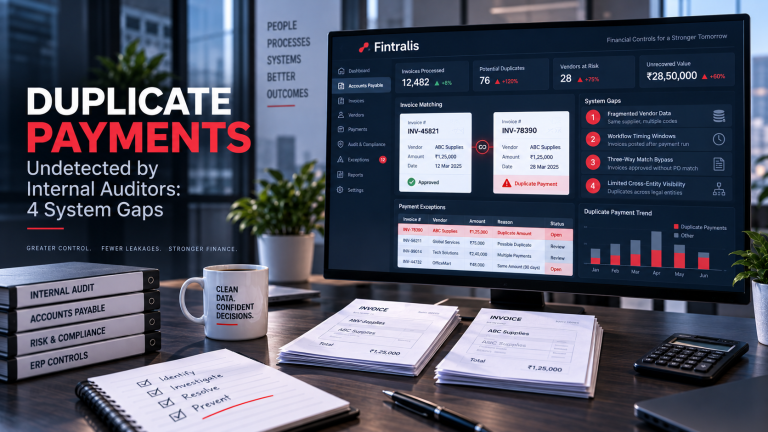
- Lack of monitoring for duplicate invoices or payments
These deficiencies create financial reporting risk. They also create opportunities for error and, occasionally, fraud. Both matter to your auditors.
Why Remediation Timelines Extend
ICFR remediation almost always takes longer than finance leaders expect. The reasons are predictable.
First, root cause analysis reveals that the problem is broader than initially identified. What looked like a single failed control turns out to be a systemic issue affecting multiple processes.
Second, implementing control redesigns requires cooperation from process owners who have other priorities. AP teams are managing daily workloads. Adding new approval steps or validation requirements slows throughput.
Third, testing takes time. You cannot declare a control effective after one successful test. Auditors require evidence that it works consistently over a defined period.
Fourth, documentation standards are higher than most organizations anticipate. Auditors need to see control design documents, evidence of performance, testing results, and sign-offs from control owners. Incomplete documentation extends remediation timelines as much as control failures do.
The Link Between Remediation and AP Recovery
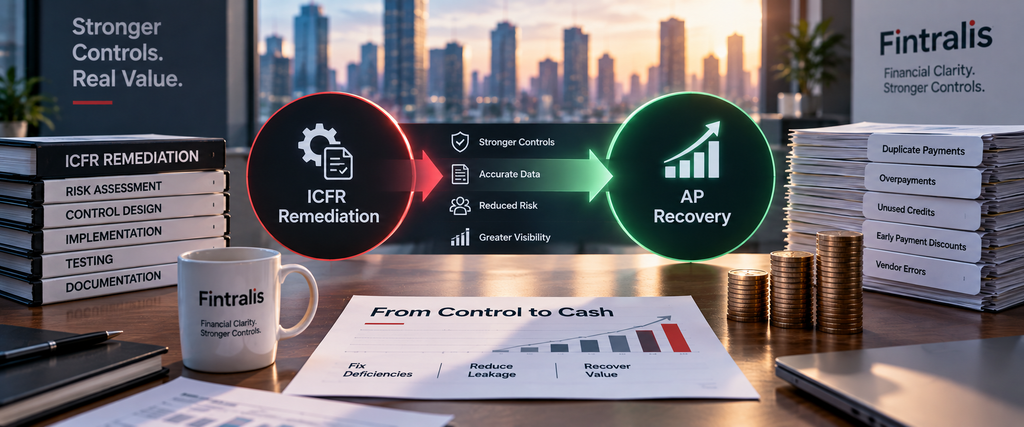
ICFR remediation fixes the control. It does not fix the errors that occurred while the control was broken.
When you remediate an AP control deficiency, you are addressing the forward risk. But the backward error population still exists. Duplicate payments made before you fixed the duplicate invoice control are still sitting in your aged payables. Pricing errors that occurred before you implemented proper contract validation are still costing you money.
Remediation and recovery are separate processes. One prevents future errors. The other recovers past losses. Both are necessary.
AP recovery audits often begin as a byproduct of ICFR remediation work. Finance identifies a control gap, remediates the design, and then asks the logical next question: what errors did this control fail to catch? That question leads to a structured review of payment history, contract compliance, and vendor file integrity.
What to Prioritize During Remediation
If you are managing ICFR remediation, prioritize material weaknesses first. Significant deficiencies matter, but material weaknesses affect your audit opinion. Address them in order of financial reporting impact, not in order of ease.
Focus on sustainable control design. Adding manual reviews that depend on one person creates a future deficiency when that person leaves. Automated controls embedded in your ERP are more reliable and easier to test.
Document as you go. Waiting until auditors request documentation adds weeks to remediation timelines. Maintain evidence files from the start.
Engage process owners early. Controls that work in theory fail in practice when the people responsible for executing them do not understand why they exist or how they fit into the broader control environment.
When Recovery Makes Sense
Not every ICFR remediation project justifies an AP recovery audit. But companies with $50M+ in annual AP spend, complex vendor relationships, or recently identified control deficiencies in payment processing should evaluate the error population before closing remediation.
If your remediation work uncovered control gaps in duplicate payment prevention, vendor file maintenance, or contract compliance, there is a recoverable error population. Fixing the control does not eliminate those losses. Recovery does.
Fintralis runs contingency-based AP recovery audits for companies operating SAP, Oracle, and JD Edwards. No upfront cost, no distraction to your AP team, and findings that validate your remediation work while returning cash to your balance sheet.
Frequently asked questions
What is ICFR remediation?
ICFR remediation is the process of fixing identified weaknesses or deficiencies in your company’s internal controls over financial reporting. It involves diagnosing the root cause, redesigning the control, implementing new procedures, testing effectiveness, and documenting the fix for auditors. The goal is restoring reliable financial reporting and avoiding material weaknesses.
How long does ICFR remediation typically take?
ICFR remediation timelines vary by deficiency type and complexity. Simple control design updates may resolve in one quarter. Material weaknesses involving segregation of duties, system changes, or organization restructuring often require two to four quarters of demonstrated effective operation before auditors will consider them remediated.
What triggers the need for ICFR remediation?
ICFR remediation is triggered when internal audit, external auditors, or management identify a control deficiency during testing. Common triggers include failed control tests, detected errors in financial statements, system implementation issues, organizational changes that break segregation of duties, or inadequate documentation of existing controls during SOX walkthroughs.
Who is responsible for ICFR remediation?
Control owners—typically department heads or process managers—are responsible for designing and implementing remediation. The CFO oversees the overall remediation plan and timeline. Internal audit validates that fixes address root causes. External auditors ultimately determine whether remediation is sufficient to change their assessment of control effectiveness.
Can ICFR remediation uncover recoverable AP errors?
Yes. When you remediate AP controls, you often discover the errors those controls failed to catch—duplicate payments, overpayments, missed rebates, or incorrect pricing. These represent recoverable dollars. Remediation fixes the forward control. Recovery addresses the backward error population. Both are necessary; neither replaces the other.
What documentation does ICFR remediation require?
ICFR remediation requires documentation of the original deficiency, root cause analysis, revised control design, implementation evidence, testing results proving effectiveness, and sign-off from control owners and auditors. For material weaknesses, you need evidence of effective operation over multiple quarters. Inadequate documentation is itself a common reason remediation timelines extend.