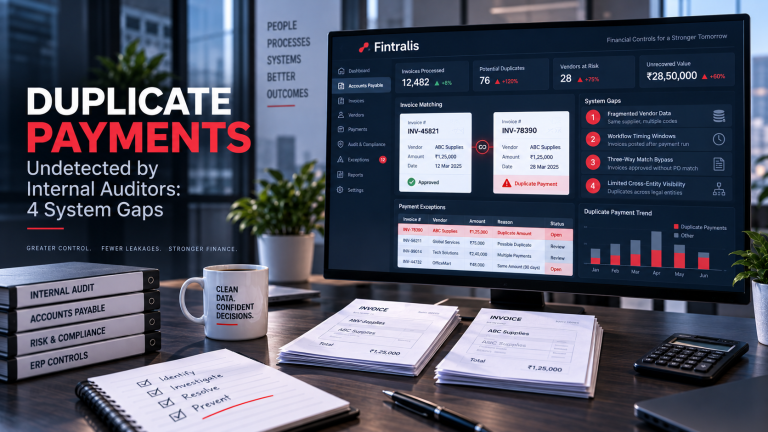

Finance leaders stepping into a new CFO role routinely discover overpayments that predecessor teams never flagged. The pattern repeats across industries: a fresh set of eyes, combined with the organizational authority to question established processes, surfaces duplicate invoices, unapplied credits and contract pricing failures that have persisted for years.
This is not a failure of competence. It reflects the structural reality of high-volume accounts payable operations where speed and relationship continuity often take precedence over forensic transaction review.
Why Incumbent Teams Miss What New CFOs See
AP departments process invoices under time pressure. Three-way matching—invoice, purchase order, receiving confirmation—should catch discrepancies, but exceptions accumulate. A vendor gets flagged as trusted after years of reliable service. PO requirements are waived for recurring charges. Freight invoices bypass matching because logistics terms are considered too complex to encode in the ERP.
Staff turnover erodes institutional knowledge. The procurement manager who negotiated a 15% volume rebate leaves the company. The AP clerk who knew that Vendor X always bills in error for a discontinued service retires. The replacement hires inherit workflows, not context.
Small variances rarely trigger investigation. A $200 overcharge on a $50,000 invoice does not cross materiality thresholds for review. When that variance repeats monthly across 18 invoices, it becomes a $43,000 exposure no single approver ever noticed.
A new CFO has no muscle memory around these exceptions. Patterns that longtime staff mentally filter as normal—”that’s just how Vendor Y invoices us”—appear immediately as control gaps.
The First 90 Days: Standard Reviews That Surface Overpayments
New CFOs conduct financial due diligence as a matter of course. Reviewing vendor spend concentration, contract compliance and approval controls is standard practice when assuming stewardship of enterprise cash flows. That routine analysis surfaces recoverable amounts.
Duplicate Payment Analysis
Run a query for duplicate invoice numbers, amounts or payment dates within the same vendor over a rolling 24- to 36-month window. ERP systems allow this; most AP teams never execute the report because daily operations leave no time for retrospective audits. New CFOs with a mandate to understand cash management run these queries in the first 30 days.
Contract Rate Verification
Pull the top 20 vendors by annual spend. Request contracts from procurement. Compare invoiced rates to contracted terms. Freight, consulting and maintenance agreements are common sources of variance. Vendors bill list rates when contracts specify discounts. Invoices include charges for service levels never purchased. These gaps persist because AP approvers do not have contract files at hand during three-way match.
Credit Memo Reconciliation
Vendor credits issued for returns, billing corrections or rebates often sit unapplied in ERP subledgers. Finance teams intend to offset them against future invoices, but tracking falls through gaps during month-end close or staff transitions. A new CFO reviewing open AP balances will spot aged credit memos that should have reduced cash outflows months earlier.
Payment Without PO
Filter for invoices paid without a purchase order. Policy may require POs for all spend above a threshold, but exceptions get approved under urgency or relationship pressure. These payments bypass the control that validates pricing, quantities and authorization. A high volume of non-PO payments signals control weakness and a higher probability of overpayment.
ERP Complexity Amplifies the Challenge
Organizations running SAP, Oracle or JD Edwards face additional layers of difficulty. These platforms support deep customization: approval workflows vary by business unit, vendor master records span multiple instances, and payment data may reside in legacy systems still partially integrated after an acquisition.
Extracting a complete payment history across environments requires ERP-specific query knowledge. New CFOs may lack that technical depth. Even skilled finance leaders find it difficult to trace a payment exception back to its root cause—whether that’s a missing tolerance check in the invoice matching configuration, a vendor master record with incorrect tax treatment, or a custom workflow that bypasses standard controls.
This complexity explains why many overpayments remain undetected until someone with the authority and motivation to cross-reference data at scale takes a structured look.
The Organizational Capital to Act
A new CFO has a time-limited window of political capital. Questioning vendor relationships, reopening closed periods and challenging procurement’s contract enforcement are easier in the first 90 days than after a year in seat. The organization expects a new finance leader to ask hard questions. That expectation provides cover to pursue recoveries that might otherwise be dismissed as relationship risk.
Existing teams manage ongoing vendor relationships and prioritize operational continuity. A CFO with enterprise accountability can absorb short-term friction in exchange for recovered cash and improved controls.
Recovery Beyond the First Find
Initial discoveries—duplicate payments, unapplied credits—are surface findings. They point to deeper issues: inadequate three-way match tolerance settings, missing contract rate tables in the ERP, approval workflows that allow overrides without secondary review.
The full recovery opportunity requires ERP-native transaction analysis across years of payment history, vendor master data hygiene and contract re-alignment. That work exceeds what a new CFO can personally execute while managing treasury, investor relations and financial planning.
Fintralis works with finance leaders who have identified these red flags and want the full exposure quantified and recovered without diverting internal resources. We operate on contingency, recovering overpayments across SAP, Oracle and JD Edwards environments and returning cash to companies with the controls now in place to prevent recurrence.
Frequently asked questions
What overpayments do new CFOs typically find first?
New CFOs most often find duplicate payments to the same vendor, freight charges billed at list rates instead of negotiated discounts, and invoices paid without matching to purchase orders. These patterns emerge quickly when reviewing payment exception reports and high-volume vendor accounts with fresh perspective on what should trigger review.
Why do existing finance teams miss recoverable overpayments?
Finance teams process thousands of invoices monthly and rely on established approval workflows that can normalize exceptions over time. Vendors may be marked as trusted, bypassing three-way matching. Staff turnover means institutional knowledge of contract terms fades. Teams prioritize processing speed over forensic review, and small-dollar variances rarely trigger investigation even when they repeat across dozens of invoices.
How long does it take a new CFO to identify overpayment issues?
Most new CFOs spot red flags in the first 30 to 60 days through standard financial reviews, vendor spend analysis and control testing. Quantifying the full exposure and building a recovery case takes longer, typically 90 to 120 days depending on ERP complexity and the cooperation of procurement and AP teams.
What ERP systems make overpayment recovery harder for new CFOs?
SAP, Oracle and JD Edwards environments with customized workflows, bolt-on modules and years of configuration changes create the most complexity. Payment data may span multiple instances, legacy systems and acquired subsidiaries. Without deep ERP expertise, new CFOs struggle to extract complete transactional histories or trace payment exceptions back to root causes in master data or approval routing.
Should a new CFO announce an overpayment review to the finance team?
Transparency about the review process builds trust, but frame it as standard financial due diligence rather than fault-finding. Focus communication on improving controls and recovering company funds, not assigning blame. Involve AP and procurement leadership early to gain their institutional knowledge and avoid defensive postures that slow recovery efforts.
What’s the first step a new CFO should take to find overpayments?
Run a duplicate payment analysis by vendor, invoice number and amount across the past 24 to 36 months. This requires minimal ERP expertise, surfaces immediate recovery opportunities and establishes baseline rigor. Next, review the top 20 vendors by spend for contract compliance, pricing variances and invoices paid outside normal tolerances. These two steps typically reveal whether a deeper audit is warranted.