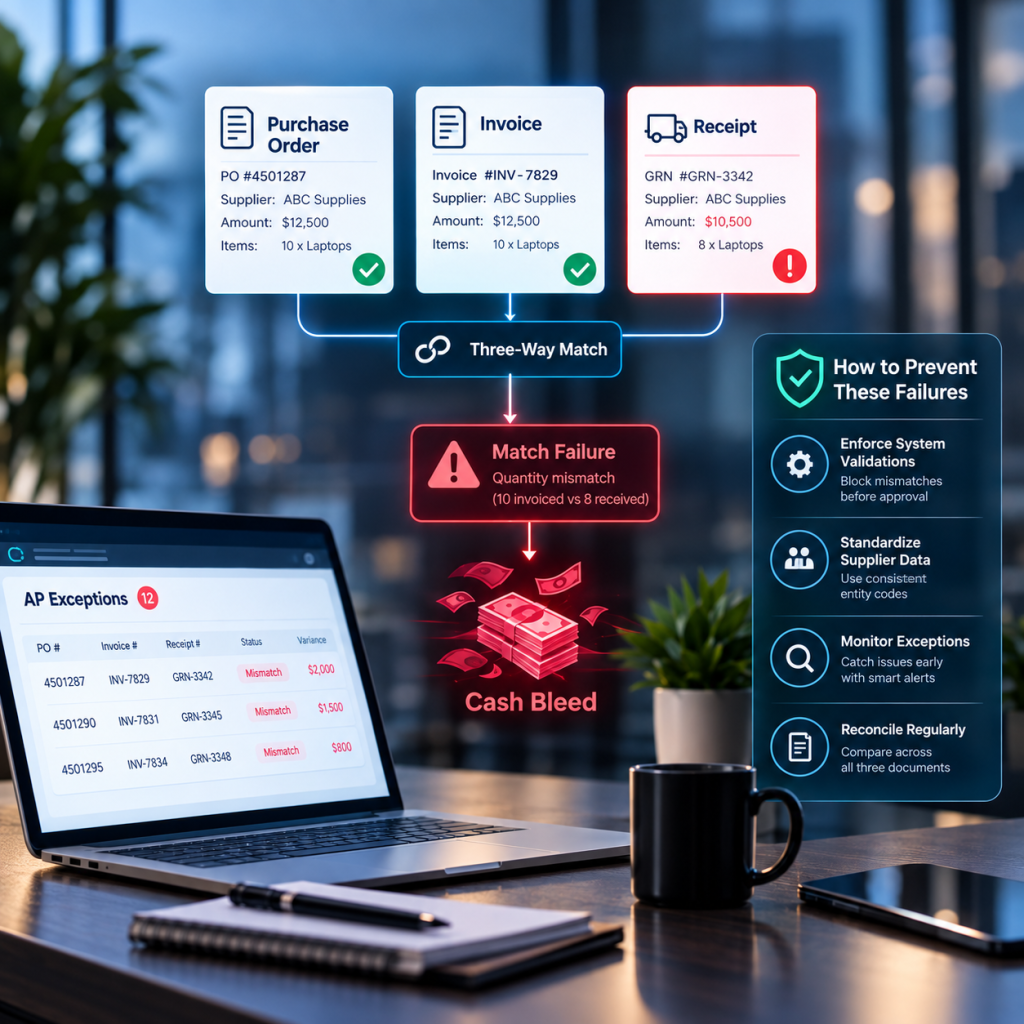
Three-way matching sits at the center of AP control frameworks. When it works, it prevents unauthorized payments and catches invoice errors before money leaves the door. When it fails, it creates manual work queues that hide duplicate payments and erode working capital discipline.
The mechanism is straightforward: match the purchase order, the goods receipt confirmation, and the supplier invoice. Payment releases only when quantity, price, and terms align within predefined tolerances. Failures indicate a discrepancy that requires investigation before payment.
Where the Process Breaks Down

Three common failure patterns account for most matching exceptions:
Quantity discrepancies. The supplier ships 98 units. Your warehouse receives 98 units. The invoice bills for 100 units. The match fails. Sometimes the shortage is real. Sometimes the receiving clerk miscounted. Sometimes the delivery included partial shipments recorded separately. Each scenario requires different investigation paths, and all of them create delay.
Price mismatches. Your buyer negotiated a revised price after issuing the purchase order but never updated the PO in the system. The invoice reflects the new price. The PO shows the old price. The match fails even though the invoice is correct. Finance queues it for review. The supplier calls asking about payment status. Your AP team spends time confirming what your procurement team already knew.
Timing gaps. The invoice arrives before your warehouse staff processes the goods receipt in the ERP system. The matching engine finds no receipt document. The invoice fails and enters an exception queue. Two days later, the receipt gets entered. But the invoice sits in the manual queue waiting for someone to retry the match. The supplier may send a second invoice. Now you have duplicate invoice risk.
How Failures Enable Duplicate Payments

Manual exception queues create visibility gaps. An invoice that fails automated matching moves to a work queue where multiple AP staff may access it. The original stays in the queue pending research. Meanwhile, the supplier resubmits the same invoice with a different invoice number or date. The resubmission may not fail matching if circumstances changed—perhaps the goods receipt was finally entered, or someone manually overrode the PO price.
Both invoices can proceed to payment through different paths. The ERP system may not flag them as duplicates because the invoice numbers differ. By the time the original exception gets resolved, the duplicate has already paid. Most duplicate payment detection happens after the fact, often when the supplier applies the overpayment to a future invoice or your team spots the double charge during a subsequent audit.
Tolerance Thresholds That Balance Control and Efficiency

Strict matching with zero tolerance creates an exception queue that overwhelms your AP team. Every rounding difference, every partial shipment, every immaterial variance stops payment and demands manual review. The control becomes a bottleneck.
Reasonable tolerance thresholds let immaterial differences pass while flagging genuine discrepancies. Common configurations:
- Quantity variance: 2-5% or a fixed unit count like 5 units
- Price variance: 1-3% or a dollar threshold like $100
- Extended amount variance: $50-$200 depending on invoice size
The specific thresholds depend on your margin structure, inventory cost volatility, and risk tolerance. A distributor with thin margins on high-volume goods needs tighter controls than a manufacturer with custom engineered components.
System Configuration That Reduces Failure Rates

Most ERP platforms support three-way matching, but implementation quality varies. Effective configurations include:
Automated goods receipt integration. Connect warehouse scanning systems directly to ERP goods receipt posting. Eliminate the delay between physical receipt and system confirmation. This removes the timing gap that causes many match failures.
PO number requirements. Configure vendor master records to require PO numbers on all invoices above a threshold. Invoices without PO numbers reject automatically before entering the matching queue. This forces suppliers to reference the correct PO and reduces invoice-entry errors.
Exception workflow routing. Route different failure types to appropriate teams. Send quantity discrepancies to receiving staff who can confirm actual quantities. Send price discrepancies to procurement buyers who can confirm negotiated rates. Keep generic AP exceptions for timing issues only.
Automatic retry logic. When a match fails due to missing goods receipt, configure the system to retry automatically every 24 hours for up to five days. This resolves timing-gap failures without manual intervention and prevents invoices from getting stuck in exception queues.
When Three-Way Matching Doesn’t Apply
Three-way matching works for purchase-order-backed goods. It doesn’t work for services, utilities, subscriptions, and other invoice types without discrete goods receipts. These require different control mechanisms:
Services typically use two-way matching between PO and invoice only, with contract terms defining deliverables and payment schedules. Utilities and recurring expenses often bypass matching entirely and use invoice-only approval workflows with variance monitoring. Low-value purchases below thresholds like $500 or $1,000 may use simplified matching or invoice-only processing to avoid control costs that exceed risk exposure.
Building Preventive Controls
Reactive matching catches errors. Preventive controls stop errors from occurring. Train receiving staff to process goods receipts within 24 hours of delivery. Require procurement to update PO prices in the system immediately after negotiating changes. Establish vendor portals where suppliers can check PO status, view receipted quantities, and confirm pricing before submitting invoices.
When suppliers have real-time visibility into what you’ve received and what pricing is in your system, invoice accuracy improves. Fewer invoices fail matching. Exception queues shrink. Payment cycle times compress. And the manual investigation workload that hides duplicate payments and processing errors decreases.
Finance teams running accounts payable on SAP, Oracle, or JD Edwards platforms handle three-way matching failures daily. Fintralis reviews completed payment runs to identify duplicate payments and overpayments that cleared those controls—recovering funds on a contingency basis with no upfront cost. If you’re interested in understanding what’s getting through your current matching framework, that’s a conversation worth having.
Frequently asked questions
What is a three-way match in accounts payable?
A three-way match compares the purchase order, goods receipt, and supplier invoice to confirm quantity, price, and terms align before payment. Payment is released only when all three documents reconcile within tolerance thresholds set by the finance team.
What causes most three-way match failures?
Most failures stem from quantity discrepancies between delivered goods and invoiced amounts, price mismatches when purchase orders weren’t updated after negotiation, and timing gaps when invoices arrive before goods are receipted in the ERP system.
How do three-way match failures lead to duplicate payments?
When the matching process fails, invoices often move to manual review queues where visibility is limited. Suppliers may resubmit the same invoice under a different number, or the original gets paid outside the system while a copy processes normally, resulting in double payment.
Should every invoice go through three-way matching?
No. Three-way matching works for purchase-order-backed goods and inventory. Services, utilities, subscriptions, and low-value items typically use two-way matching or invoice-only processing with different control mechanisms to balance fraud prevention and processing efficiency.
What tolerance thresholds prevent legitimate invoices from failing matching?
Most organizations set quantity tolerance at 2-5% and price variance at 1-3% or a fixed dollar amount like $50-$100. Thresholds depend on industry margin, item cost volatility, and whether the organization prioritizes payment speed or absolute accuracy.
How can finance teams reduce three-way match exception rates?
Reduce exceptions by training receiving staff on timely goods receipting, requiring vendors to reference PO numbers on invoices, implementing automated matching in the ERP system, and establishing vendor portals where suppliers can check PO status before invoicing.