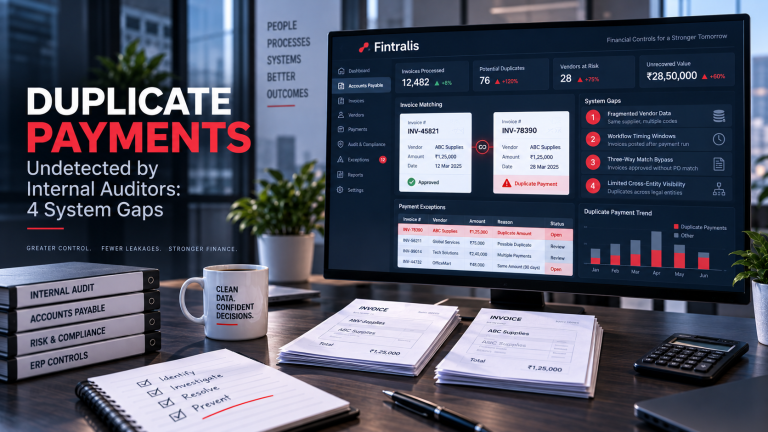

Automation in accounts payable is supposed to catch errors. In practice, it catches errors within a single system boundary. When a supplier invoices the wrong legal entity, that boundary becomes the problem.
Entity mismatch errors occur when a supplier’s invoice lands in one legal entity’s AP queue, but the underlying contract, purchase order, or service agreement sits with a different entity in your group. The result is a breakdown in three-way matching logic and, frequently, duplicate payment.
How Entity Mismatches Happen

Suppliers maintain their own records of which entity to invoice. Those records go out of date. A contract signed with Entity A in 2019 is still being invoiced to Entity A in 2024, even though the business unit moved to Entity B during a restructure in 2022. The supplier doesn’t know. Your AP team in Entity B raises a PO. Your AP team in Entity A receives an invoice with no matching PO and processes it manually. Both entities pay.
This pattern repeats wherever legal structures change. Carve-outs, spin-offs, shared service centre transitions, ERP migrations—all create gaps between the entity a supplier thinks they’re billing and the entity that actually owns the relationship.
The automation never sees it. Each ERP instance or entity code operates independently. Entity A’s workflow has no visibility into Entity B’s PO register. Entity B’s three-way match has no access to Entity A’s payment history. The mismatch lives in the space between systems.
Common Scenarios
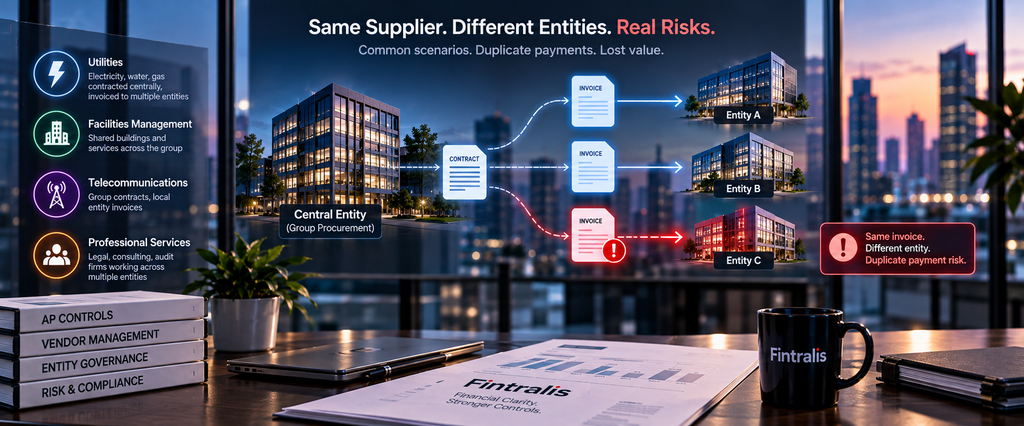
Entity mismatches cluster around certain spend categories. Shared infrastructure services—utilities, facilities management, telecommunications—are often contracted centrally but invoiced to operating entities. When the operating entity changes or a new entity is created, the supplier continues to invoice the old entity code unless explicitly updated.
Professional services present another risk. Legal, consulting, and audit firms often work across multiple entities within a group. An engagement letter may specify Entity A, but invoices arrive addressed to Entity B or the parent holding company. If both entities process and pay, the duplication may not surface until someone compares consolidated spend.
Cross-border operations add complexity. A supplier may hold one contract with your UK entity and another with your US entity, but their invoicing system treats your group as a single customer. Invoices for UK-scope work are sent to the US entity, or vice versa. Each entity’s AP team, seeing an invoice from a known supplier, processes it. Both entities pay for overlapping scope.
Why Automation Doesn’t Catch It

Automated AP workflows are designed to validate invoice data against POs and goods receipts within the same system. When an invoice hits Entity A with no matching PO, the automation flags it as an exception. That exception is typically routed for manual approval, where the approver sees a known supplier name, recognises the service, and approves payment. The fact that Entity B already paid for the same service is invisible.
Supplier master data exacerbates the issue. Most ERP systems allow the same supplier to exist under different supplier IDs in different entities, sometimes with different names or tax registration numbers. A spend analytics tool might show Entity A paying “ABC Consulting Ltd” and Entity B paying “ABC Consulting Limited” and treat them as separate suppliers. The duplication isn’t detected.
Even consolidation reporting, which aggregates spend across entities, typically happens monthly or quarterly—well after the duplicate payments have cleared. By the time finance sees the consolidated view, the cash is gone.
What to Check
Start with high-value recurring suppliers that operate across multiple entities. Compare invoice descriptions, line-item amounts, and service periods across all entity codes for the same supplier. Identical or overlapping services invoiced in the same period are the primary indicator.
Review your contract register to confirm which entity legally owns each supplier relationship. If Entity A is receiving invoices for services contracted by Entity B, you have a mismatch. Cross-reference contract ownership with PO logs and payment history to identify where payments have been made by the wrong entity.
Pay particular attention to periods following legal restructures, entity formations, or ERP migrations. These are high-risk windows where supplier billing data lags behind your internal changes.
Prevention

Preventing entity mismatches requires more than workflow automation. It requires data architecture that links contracts, POs, and invoices across entity boundaries. That typically means a centralised contract repository with clear entity ownership flags, a single supplier master that spans all entities, and workflow rules that reject any invoice sent to an entity that doesn’t hold the contract.
Supplier onboarding and maintenance processes should include entity validation. When a supplier is set up or updated, confirm which entity they should invoice. When an entity structure changes, push updated billing instructions to affected suppliers and confirm receipt.
For companies operating at scale across multiple entities, entity mismatch errors represent a measurable and recurring source of overpayment. If this describes your operation and you want to know what’s already been paid twice, a focused audit of cross-entity supplier activity will surface it. Fintralis runs that audit on contingency, recovering funds where entity mismatches have led to duplicate payment, with no cost unless recovery occurs.
Frequently asked questions
What is an entity mismatch in accounts payable?
An entity mismatch occurs when a supplier invoices one legal entity in your group but their contract or purchase order sits with a different entity. This creates a gap in three-way matching logic, often resulting in duplicate payments because neither entity’s AP system sees the full picture of what’s been paid.
Why doesn’t AP automation catch entity mismatch errors?
AP automation tools match invoice, PO and receipt within a single ERP instance or entity code. When a supplier bills Entity A for services contracted by Entity B, the automation in each system runs independently and can’t see the cross-entity duplication. The invoice in Entity A has no matching PO, so it’s processed manually or as an exception.
How common are entity mismatch overpayments in large organisations?
Entity mismatch errors increase with organisational complexity. Companies operating multiple subsidiaries, shared service centres, or recent acquisitions face the highest risk because supplier master data often lags behind legal structure changes. Every entity split or carve-out creates new mismatch opportunities until supplier records are updated.
How do I find entity mismatch duplicates in my AP history?
Compare invoice line-item descriptions and amounts across all entities for the same supplier ID or tax registration number. Look for identical services billed in overlapping periods, especially after restructures, entity spin-offs, or ERP migrations. Contract registers and PO logs should confirm which entity actually owns the supplier relationship.
Can consolidation prevent entity mismatch payment errors?
Consolidation reporting shows total spend by supplier but usually happens too late to stop payment. Real-time prevention requires centralised PO and contract ownership rules, a single supplier master across entities, and workflow that flags any invoice sent to an entity that doesn’t hold the contract.
What is the typical recovery value from entity mismatch audits?
Recovery value depends on how many legal entities you operate and how frequently you restructure. Entity mismatches typically surface as a subset of broader duplicate payment pools, often involving high-value service contracts that span multiple entities or shared infrastructure invoices that multiple subsidiaries pay independently.