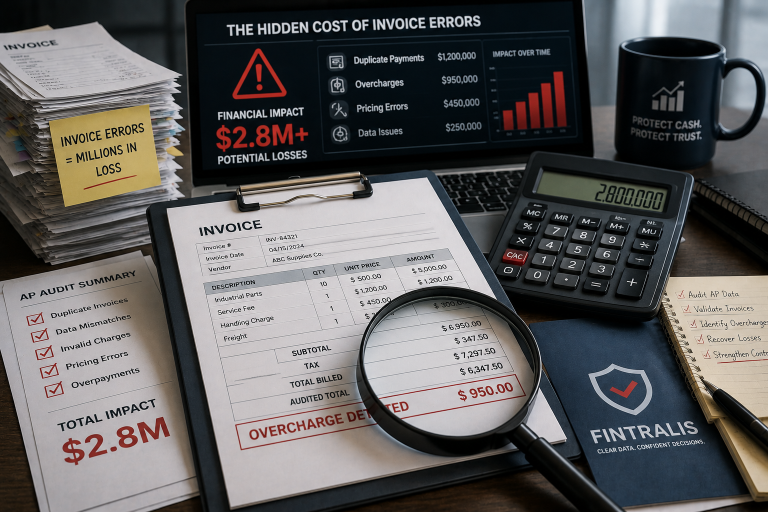

Overpayments don’t usually announce themselves. If you run SAP’s standard duplicate-payment report and find nothing, that doesn’t mean you’re clean. It means the obvious cases are handled. The recoverable money sits deeper in your transaction history, spread across posting chains that look routine on their own but add up wrong when you trace them through.
Where Overpayments Actually Live
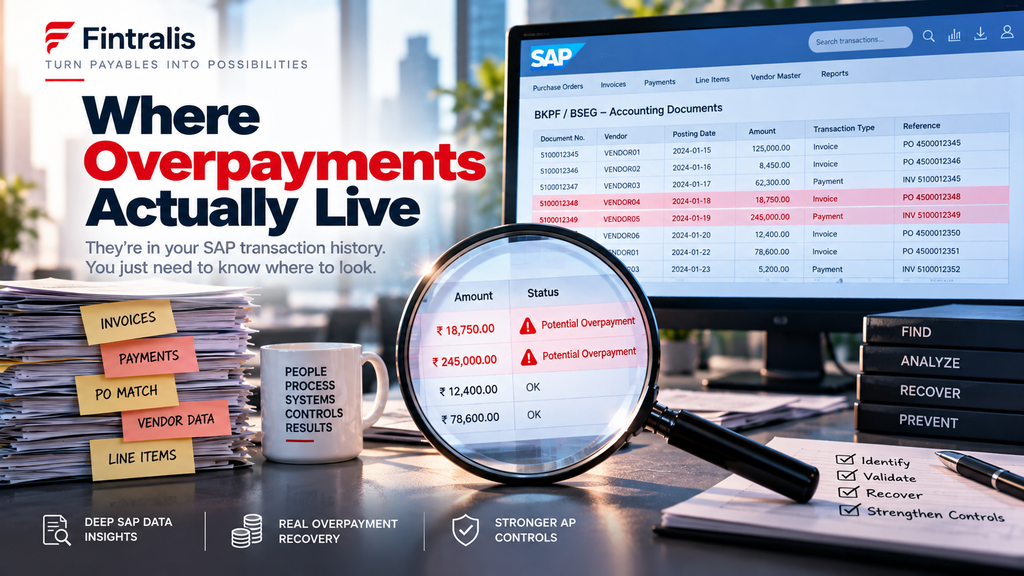
Three transaction patterns account for most recoverable amounts. First, partial reversals that never got reapplied. A buyer disputes a line item, finance posts a credit memo, the vendor corrects the invoice, but the new charge never posts. The original overpayment stays paid. SAP shows a clean reversal, so no report flags it.
Second, reference-number variations. Same vendor, same amount, same period, different PO or invoice reference. One payment clears against the wrong document while the correct document also gets paid. Standard duplicate logic doesn’t catch it because the document numbers differ.
Third, PO-to-invoice mismatches that clear anyway. Procurement changes a PO quantity or price after an invoice is already in workflow. Finance pays the invoice because it matched when it entered the queue. The PO change never triggers a review. You’ve paid the old amount on a document that no longer reflects the agreed terms.
Why Standard Reports Miss These
SAP’s native duplicate-payment reports compare vendor ID, amount and date within a rolling window. If those three fields match, the report flags it. That works for identical invoices entered twice on the same day. It doesn’t work for anything more complicated.
Partial reversals don’t look like duplicates because the second transaction is a credit, not a payment. Reference mismatches don’t match because the document numbers differ by one digit or one suffix. PO changes don’t trigger alerts because the invoice was valid when it posted, even if the underlying purchase order changed an hour later.
Tracing these patterns requires joining tables across FI and MM modules, matching line-item detail from invoice receipts to goods receipts to purchase-order history, then netting the resulting chains by vendor and period. Standard reporting doesn’t do that. It checks individual document headers.
What to Look for in Transaction Logs
Start with reversal documents that have no matching forward posting in the subsequent sixty days. Pull all credit memos by vendor for the past two years. For each one, search forward for a replacement charge. If you find the credit but no replacement, check whether the underlying dispute was resolved. If it was, you probably paid the original invoice and never collected the correction.
Next, group payments by vendor, then by rounded amount. Sort by date. Look for pairs of payments within ninety days of each other that match to the nearest hundred or thousand. Compare their reference fields. If the references differ by a single character or a trailing suffix, pull both invoices. Compare them line by line. One may be the original, the other a corrected reissue that should have replaced the first payment, not supplemented it.
Finally, pull all invoice payments where the PO line-item price or quantity changed within thirty days after the invoice date. Flag any where the payment amount matches the original PO line and the invoice date is earlier than the PO change date. Those are invoices paid at old terms that were already superseded by a procurement change.
How Deep the Problem Usually Goes
Transaction volume matters more than company size. An operation processing fifteen thousand supplier invoices a month will have more buried overpayments than one processing three thousand, even if the latter has higher AP spend. The issue is process complexity, not payment scale.
Cross-module workflows introduce the most risk. Any process that requires a handoff between procurement and finance, or between a subsidiary ledger and the central FI module, creates opportunity for transaction chains to fall out of sync. The more approval layers and system touchpoints, the more likely a reversal or correction will clear in one module but not propagate to another.
What You Can Do About It

Manual audits catch some of this if you know what to look for, but the labor cost usually exceeds the recovery unless you have a narrow scope or a known problem area. Automated transaction analysis pays for itself when you’re processing thousands of supplier payments a month and haven’t done a deep match in the past two years.
If you want an outside team to run the analysis on a contingency basis, you pay nothing upfront and keep most of the recovery. That model makes sense if you don’t have internal resources to dedicate to multi-table transaction matching, or if you’d rather confirm there’s something to recover before committing time to it. The trade-off is you share a percentage of what gets found, but you avoid fixed consulting fees for work that may turn up little or nothing.
Frequently asked questions
Where do most overpayments hide in SAP transaction data?
Most overpayments sit in routine transaction logs as partial reversals that weren’t reapplied correctly, duplicate payments with slightly different reference numbers, or invoices paid multiple times across different purchase orders. They don’t show up as obvious line-item errors and often span multiple fiscal periods.
What transaction patterns typically indicate a duplicate payment?
Look for identical vendor, amount and near-identical dates with different document numbers. Also watch for payments that match an invoice amount but reference different PO numbers, and any reversal postings that don’t net to zero when traced through the full chain.
Can standard SAP reports catch all overpayments automatically?
Standard SAP reports catch obvious duplicates but miss most overpayment scenarios because they don’t cross-reference partial reversals, trace PO-to-invoice chains across modules, or flag reference-number variations. Most recoverable overpayments require transaction-level analysis across multiple tables and fiscal periods.
How far back should we look for overpayments in SAP data?
Recovery feasibility usually extends three to five years depending on vendor recordkeeping and statute of limitations. Practical yield concentrates in the most recent eighteen to thirty-six months because older records often lack the supporting documentation vendors require to process refunds.
What’s the difference between an overpayment and a duplicate payment?
A duplicate payment is one overpayment type where the same invoice gets paid twice. Overpayments include duplicates but also cover partial reversals never reapplied, price discrepancies, quantity mismatches, and payments made against incorrect PO line items. Duplicates are easier to prove; other overpayment types require deeper transaction analysis.
Do overpayments usually result from user error or system problems?
Most stem from process gaps, not individual mistakes. Common causes include invoice-PO matching rules that allow partial reversals to fall through, approval workflows that don’t catch reference-number variations, and cross-module handoffs where procurement and finance systems don’t reconcile line-item changes. User error accounts for a minority of recoverable amounts.