
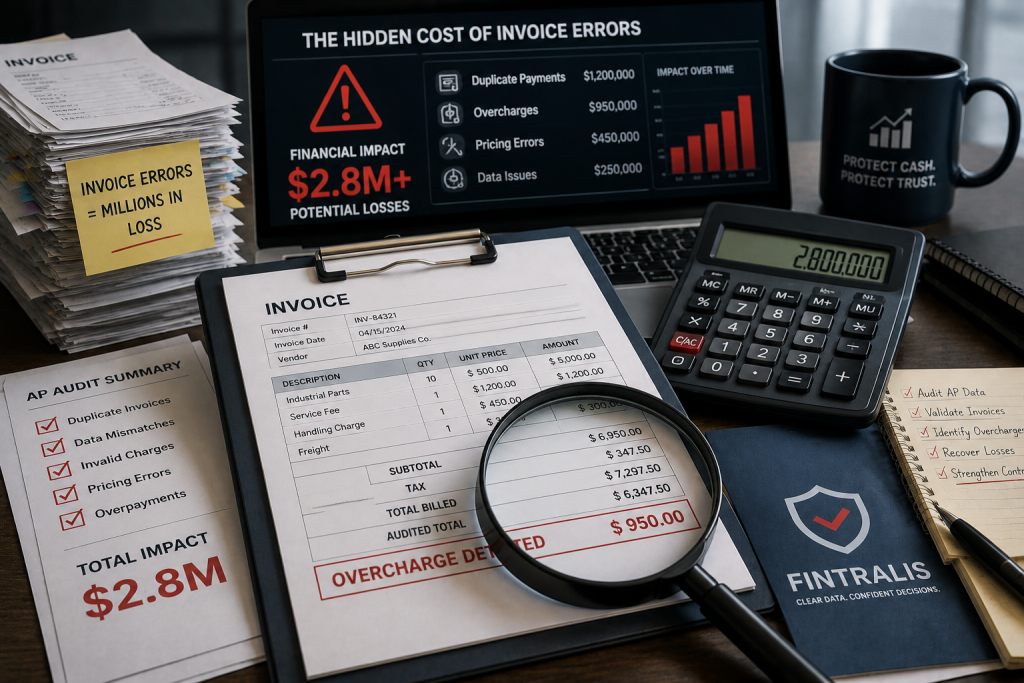
Most finance teams assume their ERP catches payment errors. It does not. SAP, Oracle and JD Edwards will flag an invoice that fails three-way match, but they do not audit whether the contracted price on the PO is correct, whether a supplier charged twice for the same service in different periods, or whether fees listed on the invoice reflect work actually performed.
Supplier overcharges accumulate in the payment history of every mid-market and enterprise company. They sit unchallenged because accounts payable is a processing function, not an audit function. AP clerks verify that an invoice matches a PO and that goods were received. They do not cross-check every line item against master service agreements, compare current invoices to prior payments for duplicates, or validate that tiered pricing reflects actual volume.
The Overcharges Your AP Team Does Not Catch
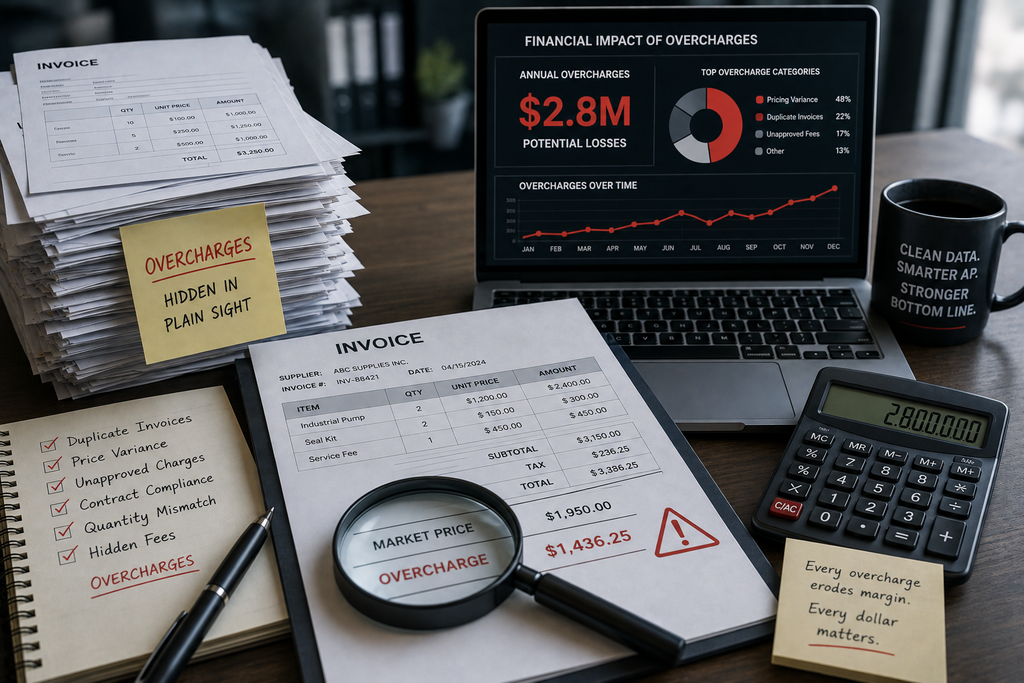
Duplicate payments are the most obvious example. A supplier submits an invoice in November, receives payment in December, then resubmits the same invoice with a new invoice number in January. If the PO is still open and the amount is within tolerance, the ERP clears it. The duplicate is not caught unless someone manually reviews payment history or runs a forensic report looking for matching amounts and descriptions.
Pricing errors are more common. A supplier bills at list price when the contract specifies a discounted rate. Or the contract includes volume tiers, but the supplier continues billing at the higher tier after you cross the threshold. Or a rate increase takes effect, and the supplier back-dates it to invoices already in process. AP does not have time to verify contract terms for every line item on every invoice. The payment processes, and the overcharge becomes permanent.
Freight and service charges are another vector. Suppliers add handling fees, fuel surcharges, expedite fees and administrative charges that are not in the contract or were never delivered. AP sees a line item labelled “logistics fee” or “processing charge” and assumes it is legitimate. The invoice matches the PO, which was cut at the inflated amount, so the payment clears.
Rebate shortfalls represent a more sophisticated form of leakage. If your agreement includes volume rebates or year-end credits, the supplier calculates what is owed and issues a credit memo. Finance teams rarely audit the rebate calculation. If the supplier uses the wrong volume base, applies the wrong tier, or excludes certain product categories, the shortfall is invisible unless your team reconstructs the calculation from transaction records.
Why ERP Controls Are Not Enough
The three-way match is a control for whether an invoice corresponds to authorised activity. It is not a control for whether the activity was priced correctly, billed once, or delivered as invoiced. If a supplier sends an invoice that matches a flawed PO, the ERP will approve the payment. The system does not hold institutional memory of what the price should have been, or whether an identical invoice was paid ninety days earlier under a different PO.
Workflow automation accelerates this process but does not audit it. Automated invoice capture and routing move payments through the system faster, which means pricing errors and duplicate invoices also clear faster. The efficiency gain is real, but it does not replace the need to verify that what you are paying is what you owe.
Finance teams that rely entirely on ERP controls leave money on the table every month. The overcharges are not dramatic. They are scattered across thousands of transactions, each one small enough to stay below AP’s materiality threshold. Cumulatively, they represent a sustained leak that most CFOs never measure.
What an AP Audit Uncovers
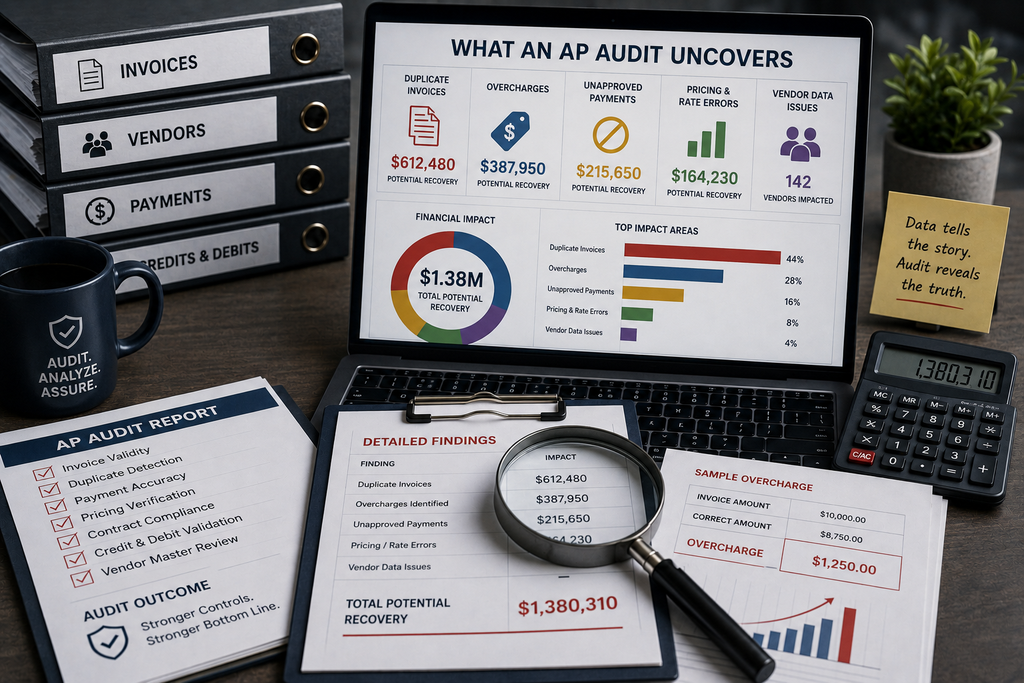
A proper accounts payable audit compares what you paid to what you should have paid. That requires matching payment transactions to the contract terms that govern them, checking for duplicate payments across periods, and identifying charges that have no corresponding delivery or service record.
The process is data-intensive. Payment history, PO detail, contract pricing schedules, receiving records and rebate agreements all need to be cross-referenced. Most finance teams do not have the bandwidth to do this work continuously, which is why the errors accumulate.
When the audit is done systematically, the findings are consistent across industries. Duplicate payments show up in every data set. Pricing discrepancies are routine. Service charges that cannot be tied to any deliverable appear on a meaningful percentage of supplier invoices. The overcharges are not the result of fraud—they are the result of process complexity and the absence of ongoing verification.
Recovering Overcharges
Suppliers will issue credits when presented with documentation. If you can demonstrate that a payment was duplicated, that pricing exceeded the contract rate, or that a charge was billed without delivery, most suppliers respond with a credit memo. The commercial relationship usually continues, and the supplier has no interest in contesting a claim that is clearly supported.
The obstacle is not supplier cooperation. It is the work required to identify and document each recoverable error. Finance teams that attempt this internally find that the data analysis and supplier negotiation consume more time than the project is worth, unless they can dedicate resources specifically to the task.
An alternative is to engage an AP recovery service that works on contingency. The service pulls transaction data from your ERP, runs the audit, documents the findings, and works with suppliers to recover overcharges. You pay only on what is collected, which eliminates execution risk. For companies with $50 million or more in annual accounts payable spend, the recoveries typically justify the engagement within the first cycle.
Frequently asked questions
What types of invoice errors do CFOs typically miss in their ERP systems?
Duplicate payments to the same supplier, pricing that exceeds contracted rates, and freight or service charges billed but not delivered are the most common. Rebate shortfalls and incorrectly applied discounts also represent material leakage. Most ERPs flag obvious duplicates, but errors involving partial variances or timing differences pass through unnoticed without manual review or pattern-matching tools.
How much money do companies lose to supplier overcharges each year?
The actual amount varies by vendor management discipline and AP transaction volume, but organisations with weak invoice controls routinely forfeit five to seven figures annually. Overcharges accumulate across thousands of line items—small dollar errors compound, and a single duplicate payment to a major supplier can run into six figures. Without systematic auditing, the leakage continues indefinitely.
Why don’t ERP three-way match controls catch supplier overcharges?
Three-way matching confirms an invoice matches a purchase order and receiving document, but it does not verify that the PO itself reflects the contracted price, that quantities received were actually consumed, or that service fees are legitimate. If a supplier invoices at an incorrect tier or adds undocumented charges, and the PO was cut at that same incorrect amount, the match succeeds and the overpayment clears.
Can finance teams recover money already paid to suppliers for invoice errors?
Yes. Suppliers will issue credits when presented with documentation of duplicate payments, pricing discrepancies against master agreements, or charges for services not rendered. The practical challenge is identifying which payments are recoverable and assembling the evidence. Most suppliers respond cooperatively when the claim is specific and supported, particularly when the relationship is ongoing.
What data does a CFO need to audit accounts payable for overcharges?
Payment transaction history, purchase orders, supplier master agreements, and receiving records are the foundational data sets. Invoice-level detail is essential, including line-item descriptions, GL coding, and payment dates. Contract pricing schedules and rebate terms provide the benchmarks. All of this typically resides in SAP, Oracle or JD Edwards, though contract data may live in separate procurement systems.
Is it worth auditing AP if our company already uses automated invoice processing?
Automated processing accelerates matching and approval workflows, but it does not audit for pricing accuracy, duplicate payments across time periods, or phantom charges. Workflow automation still relies on the integrity of the underlying PO and contract data. If those contain errors—or if suppliers introduce variances—the automation propagates the mistake at scale. Regular audits remain necessary regardless of processing technology.