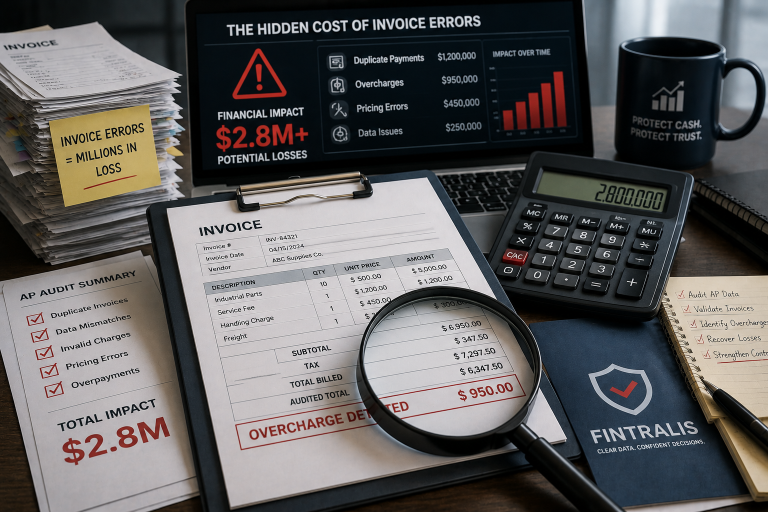

Most finance leaders know, intellectually, that AP overpayments happen. Duplicate invoices slip through. Pricing variances go unnoticed. Credits sit unapplied. The assumption is that the dollar impact is minor—a rounding error against overall spend.
That assumption is usually wrong by a factor of two or more.
The gap between perceived and actual AP leakage isn’t a measurement problem. It’s a visibility problem. Your AP team sees individual exceptions. You see summary reports. Nobody sees the aggregate exposure because nobody has extracted and analysed the full transaction set across invoice, payment, and vendor master records.
Why Internal Estimates Miss the Mark

AP teams typically estimate leakage based on exceptions they’ve already caught—duplicate payments flagged by a vendor, pricing disputes raised during invoice approval, obvious keying errors corrected before payment. That sample is biased toward the most visible failures.
The larger buckets stay hidden:
- Duplicate payments separated by enough time that your ERP’s standard duplicate-check window doesn’t flag them
- Pricing variances on contracted line items where the invoice references a PO but the rate is wrong
- Credit memos applied to the wrong invoice or customer account, leaving the original overpayment unreconciled
- Intercompany payments that clear in one entity but post incorrectly in another, creating a phantom payable and a real overpayment
- Freight, tax, or currency conversion errors that compound across high-volume vendors
These categories don’t surface in monthly close reports. They don’t trigger AP aging alerts. They sit in your ERP as clean, closed transactions until someone runs the specific query designed to find them.
The Three-Part Baseline Process

Validating the real size of your AP overpayment problem requires three distinct analyses, each with its own data set and matching logic.
Duplicate Payment Analysis
Export five years of AP payment history if your ERP retention supports it—three years minimum. Match payments to the same vendor using invoice number, invoice date, invoice amount, and payment amount as overlapping criteria. Your ERP’s duplicate check typically runs at time of invoice entry with a 30- or 60-day window. Payments separated by four months but referencing the same invoice number and amount won’t trigger that control.
The analysis also needs to catch near-duplicates: same vendor, same amount, invoice numbers off by one character or one transposition. Those are often re-keys after a payment inquiry or a manual workaround.
Pricing Variance Check
Pull your contract rate tables and cross-reference invoice line items for your top 200 vendors by spend. This works only if you have digitised contract pricing or supplier agreements that specify unit rates, volume tiers, or discount schedules. The goal is to flag invoices that cleared AP approval but were priced above the contracted rate.
This category also includes quantity variances—invoice quantities that exceed PO or receiving quantities, particularly on partial shipments or consignment arrangements.
Credit Balance and Unapplied Payment Review
Run a vendor credit balance report for all vendors with a negative payable balance. That’s your starting list of overpayments the ERP already knows about but hasn’t resolved. Cross-check unapplied payments—cleared checks or wire transfers that posted to the vendor master but never matched to an open invoice.
For multi-entity environments, this step has to run at the consolidation level. A credit balance in Entity A and an open payable in Entity B to the same vendor group often indicates an intercompany process failure.
What the Baseline Tells You
These three analyses produce two critical numbers: your standing exposure and your annual leakage rate.
Standing exposure is the sum of recoverable overpayments currently on your books or sitting with vendors as unreconciled credits. That’s cash you’ve already spent incorrectly. It doesn’t grow unless you keep making the same errors.
Annual leakage rate is the dollar value of new overpayments created in the most recent 12-month period. That’s your run rate—the amount leaving the business each year through AP process failures. If you fix nothing, that number compounds.
The combination gives you a business case for intervention. If your standing exposure is $1.2M and your annual leakage is $400K, you’re looking at a three-year payback just from stopping the bleeding, ignoring any recovery of prior-year amounts.
The Resource Trade-Off

Running this baseline internally is possible if you have available IT and AP capacity. Data extraction is the bottleneck—most ERPs don’t make it easy to pull five years of invoice and payment detail with vendor master linkage intact. The matching logic and variance analysis then require either custom SQL or manual sampling in Excel.
External recovery firms run this process as part of their standard engagement, typically on a contingency model. The trade-off is control and timing. You get the analysis at no upfront cost and benefit from pattern recognition across hundreds of prior audits, but you wait longer for results and hand over data access.
Either path works. The error is skipping the baseline entirely and assuming your AP leakage is small because you haven’t looked.
If your AP spend exceeds $50M annually and you’re running SAP, Oracle, or JD Edwards across multiple entities, the likelihood that your real exposure is materially larger than your internal estimate is high. Validating that number is the first step toward plugging the gap.
Frequently asked questions
What percentage of companies have undetected AP overpayments?
Most mid-market and enterprise companies have some level of AP leakage, though the dollar amount varies widely based on transaction volume, ERP complexity, and control environment. The issue isn’t whether overpayments exist—it’s whether you’ve measured them systematically. Companies with decentralised procurement or multiple ERP instances typically carry higher undetected balances.
How do I estimate the size of my AP overpayment exposure?
Run a three-part baseline: duplicate payment analysis across invoice and payment history, pricing variance checks against contracted rates, and a credit balance report by vendor. Export five years of AP transaction data if your ERP retention allows it. The combination shows your standing exposure and your annual leakage rate, which you can then project forward.
What’s the typical recovery rate from AP overpayment audits?
Recovery rates depend entirely on the age and nature of the overpayments found. Balances under two years old and supported by clear documentation recover at materially higher rates than older, disputed amounts. The recovery rate is less important than the identification rate—most companies don’t know what they’re missing in the first place.
Should I validate AP overpayments myself or use an external firm?
Internal validation gives you faster visibility but demands scarce AP and IT resources for data extraction, duplicate matching logic, and variance analysis. External contingency-based firms run the analysis at no upfront cost and typically find categories of leakage your team wouldn’t flag, particularly in ERP-layer issues and vendor credit tracking. The trade-off is timeline and control.
Which ERP systems are most prone to AP overpayment issues?
SAP, Oracle, and JD Edwards environments all accumulate AP leakage, but the failure modes differ. SAP installations with multiple company codes and intercompany flows create duplicate exposure. Oracle E-Business Suite and Cloud environments can lose track of credit memo applications. JD Edwards sites often carry manual workarounds that bypass standard controls. Complexity drives leakage more than platform choice.
How far back should I look for AP overpayments?
Practical recovery typically reaches back three to five years depending on vendor record retention, your own transaction history in the ERP, and the statute of limitations in relevant jurisdictions. Beyond five years, data quality degrades and vendor willingness to engage drops sharply. Start with the most recent 24 months to baseline your current-state leakage, then extend backward if early results justify it.