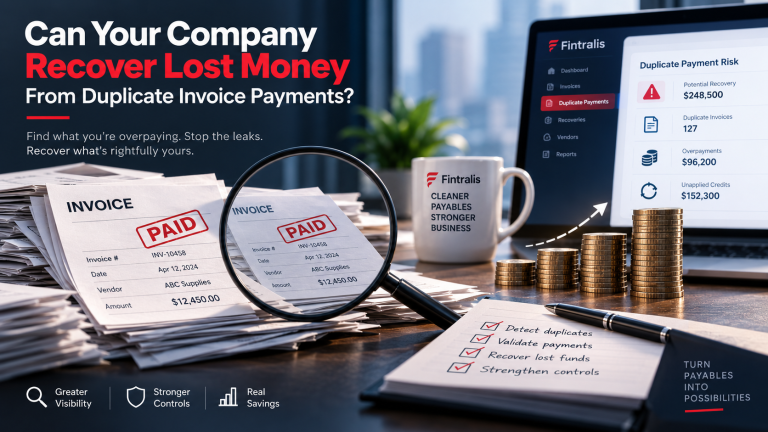

Duplicate invoice payments are one of the most common AP errors in companies with $50M+ annual spend. Despite three-way matching and ERP validation rules, invoices get paid twice. The money leaves your account, the vendor credits their receivables, and unless someone manually compares payment runs, the duplication goes unnoticed until a recovery audit surfaces it.
How Duplicates Bypass Standard Controls
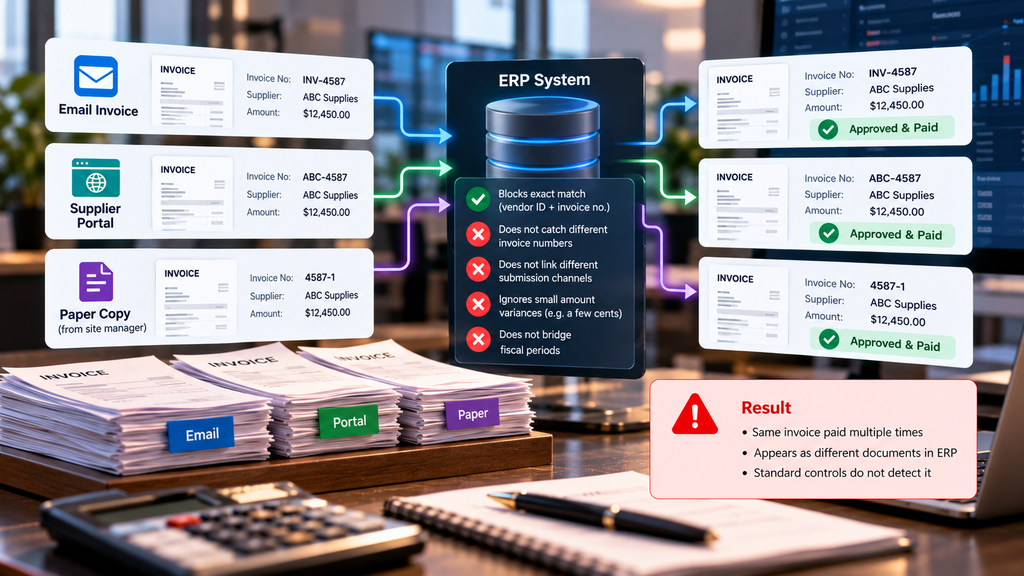
Your ERP blocks identical vendor ID and invoice number combinations. That rule catches exact duplicates submitted on the same day. It does not catch the same invoice arriving through different channels—one by email, one through a supplier portal, one as a paper copy forwarded by a site manager.
The system assigns each submission a different document ID. AP clerks see different headers. If the amounts differ by a few cents due to rounding or currency conversion, the matching rule does not trigger. If the invoice spans two fiscal periods, one half clears in Q4 and the other in Q1, and your search filters do not bridge the cutover.
Vendors resubmit invoices when payment is late. The original invoice is already in workflow. The resubmission enters as a new line. If approval routing differs—first invoice to site controller, second to central AP—both clear separately. Partial payments create the same problem: invoice for $100K, payment for $60K, vendor reissues for the remaining $40K but also resubmits the original $100K with a note. AP sees “balance due” and processes the $40K against the new document number, then later processes the full $100K under the original reference.
Why Manual Review Does Not Scale
Manual review works for low transaction volumes. When you process thousands of invoices monthly, a clerk cannot visually compare every payment against prior history. The review happens at approval stage, not at payment execution. Once an invoice is approved, it enters the payment queue. Payment runs process automatically on scheduled dates. The gap between approval and payment is where duplicates slip through.
Shared service centers compound the issue. If three regional teams approve invoices for the same vendor, each team sees their own subset. The vendor invoices the same service to two regions, or invoices corporate and also invoices the operating entity. Both are valid from a PO standpoint, but the underlying service was delivered once. Your AP team does not have visibility across entities unless you consolidate vendor master records and run cross-entity duplicate checks.
What Recovery Audits Find
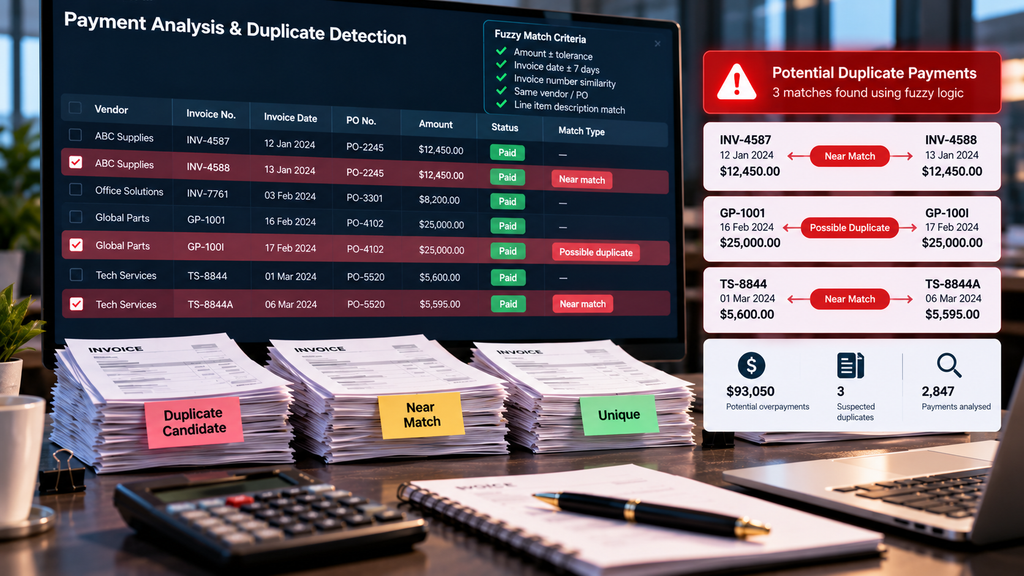
A recovery audit compares every payment against every other payment on multiple identifiers: vendor, amount, invoice date, invoice number, PO number, and line item description. Exact matches are obvious. Near matches require fuzzy logic—invoice numbers that differ by one character, amounts within a small tolerance, dates within a week of each other.
Audits also flag patterns. A vendor submits monthly invoices for $50K. One month shows two payments of $50K three days apart. The invoice numbers are sequential, which suggests resubmission rather than two distinct invoices. Your AP records show one PO with one delivery confirmation, which means one invoice should have been paid.
Recovered funds come from two sources: vendor refunds and account credits. Some vendors refund duplicate payments immediately. Others apply a credit to your account, which reduces future invoices. Either outcome is cash back to your company. The credit route is faster because it does not require a treasury transaction, but it depends on having ongoing spend with that vendor.
Prevention After Recovery
Recovery audits tell you where controls failed. If the same vendor appears multiple times in the recovery report, investigate why. It may be that the vendor submits through multiple channels and your AP team lacks a central intake. It may be that invoice numbering is inconsistent and your matching rule is too narrow.
Strengthen duplicate detection by expanding match criteria. Check invoice number, amount, vendor, and invoice date simultaneously. Add tolerance bands—flag invoices within 5% of a prior payment to the same vendor in the past 90 days. Route flagged invoices to a senior AP analyst for manual verification before payment.
Centralize vendor communication. If a vendor wants to resubmit an invoice, require them to reference the original submission. Train AP staff to search payment history before approving any resubmission. If your ERP supports it, lock invoice numbers after first entry so that a duplicate number cannot be reused even if other fields differ.
When to Audit
Run a recovery audit if you have never done one, if you have grown by acquisition, or if you have migrated ERP systems in the past three years. Each scenario introduces duplicate risk. Acquisitions mean multiple legacy vendor files. Migration means data conversion errors and incomplete historical match logic.
A contingency recovery model means you pay only on funds recovered. The audit firm takes a percentage of collected duplicates. There is no upfront cost and no fee if nothing is found. That structure makes sense when you do not have internal audit bandwidth to run a full transaction analysis.
If you are a CFO or Finance Director at a company running SAP, Oracle, or JD Edwards with $50M+ annual AP spend, a recovery audit will find duplicates that cleared your existing controls. The funds are recoverable, and the findings give you a roadmap to prevent recurrence.
Frequently asked questions
What causes duplicate invoice payments in accounts payable?
Duplicate payments occur when different copies of the same invoice enter the AP system separately—one by email, one by portal, or multiple submissions by a vendor. Invoices that span fiscal periods, split POs, or partial payments also create matching failures that result in double payment.
How often do companies pay the same invoice twice?
Most mid-market finance teams discover duplicate payments during recovery audits, indicating that preventive controls miss a measurable portion. The rate depends on transaction volume, system integration, and vendor behavior, but manual review alone does not scale to catch every instance.
Can ERP systems automatically prevent all duplicate invoice payments?
ERP systems block exact duplicates on vendor ID and invoice number, but they cannot catch near-duplicates where a vendor submits the same invoice with a revised date, slightly different amount, or different PO reference. These variants bypass standard matching logic.
What is the best way to recover duplicate invoice payments?
Recovery audits identify duplicates that cleared AP review, then finance teams request refunds or apply credits to future invoices. A forensic audit checks multiple identifiers—amount, date, line items—across transaction history to find matches that automated rules missed.
Should I rely on vendor statements to catch duplicate payments?
Vendor statements show your remittances but do not flag when you paid the same invoice twice. Vendors are not incentivized to notify you of overpayments. Recovery requires your own cross-check of payment and invoice records.
How far back should I audit for duplicate invoice payments?
Audit at least three years of transaction history, which is the typical window before payments become uncollectible. Older records are harder to reconcile, and vendor cooperation drops after year three.