
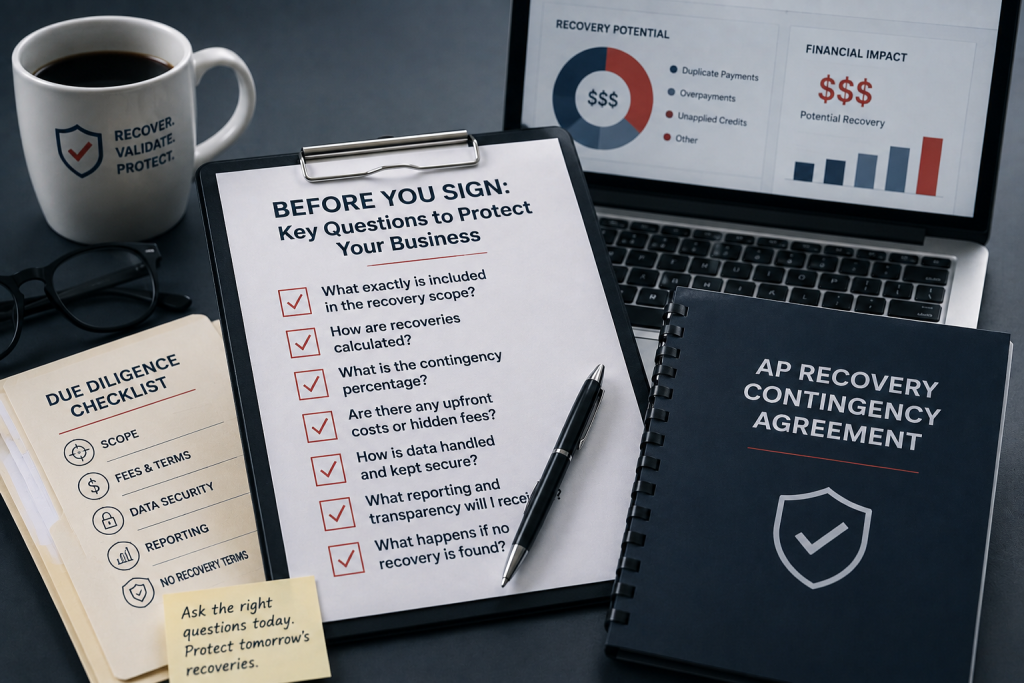
Most AP recovery agreements look identical in the first two pages. The differences that matter sit in schedules, definitions, and carve-outs—the sections written after the template. Those clauses determine whether you hand over twelve percent of every duplicate payment or whether you keep control of margin-protecting relationships and limit exposure to genuine waste.
Here are the contract points finance leaders should clarify before signature.
What triggers the contingency fee
The fee denominator matters. Some contracts calculate the percentage against gross recoveries. Others apply it to net cash returned after vendor deductions, offsets, or applied credits. A supplier might agree to a fifty-thousand-dollar correction but apply thirty thousand against open invoices. Under a gross-fee structure, you pay the recovery firm on fifty thousand. Under a net structure, you pay on twenty.
Ask which figure the percentage applies to and whether partial recoveries, credits, and offsets reduce the fee base.
Who owns the supplier conversation
Recovery work requires contacting your vendors. Some agreements let the third party reach out directly under their own name. Others require the provider to work through your AP team or use your email domain. Direct contact can speed up obvious cases—duplicate PO matches, for instance—but introduces risk when the vendor relationship carries pricing, volume, or strategic weight.
Confirm whether the agreement requires your approval before each supplier contact, limits outreach to specific vendor tiers, or gives the provider standing authority to correspond on your behalf.
How disputes and chargebacks are handled
A recovered payment can reverse. A vendor might issue a credit, then issue a debit two quarters later when they locate a proof of delivery. The question is whether your contingency fee refunds when the recovery unwinds.
Some contracts treat each event separately: you pay on the credit, and you are not reimbursed when the chargeback appears. Others include a clawback provision that refunds fees if a recovery is reversed within a defined window. Ask what happens when a vendor disputes a recovery after you have already paid the success fee.
Carve-outs for supplier negotiations and commercial settlements
Finance teams negotiate with suppliers all the time—early-payment discounts, volume rebates, pricing corrections. If your agreement does not carve out commercial discussions, the recovery firm may claim a fee on a rebate you negotiated six months ago simply because the credit memo appeared during the contract term.
Require a clear definition of what constitutes a contingency-eligible recovery versus a commercial settlement. Confirm that negotiated rebates, pricing adjustments, and explicitly excluded categories remain outside the fee calculation.
Access boundaries and data retention
Recovery providers need read access to payment histories, PO records, and supplier master files. The contract should define which systems they can query, whether they can export data, and how long they retain copies after the engagement ends.
Ask whether the provider will store your payment data offshore, who holds the deletion obligation when the contract terminates, and whether their access is read-only or includes write privileges in any system.
Liability caps and indemnity limits
No audit is risk-free. A provider might misidentify a valid payment as duplicate, prompting you to request a refund that damages a supplier relationship or triggers a breach-of-contract claim. The agreement should state the provider’s liability limit and whether they indemnify you for claims arising from their errors.
Many contingency contracts cap liability at fees paid to date. If the engagement is young, that may be a small number relative to the commercial risk of a disputed recovery.
Term, renewal, and wind-down
Some agreements auto-renew unless you provide ninety-day notice. Others include a tail period during which any recovery initiated before termination still attracts a fee, even if the cash arrives months later. Understand the minimum term, the notice requirement, and whether the provider can continue work on open claims after you end the relationship.
Exclusivity and overlap with other audits
If you run a separate duplicate-payment control, early-payment discount tracker, or vendor self-audit program, the contract should clarify which recovery stream each party owns. Overlapping claims create internal friction and duplicate fees on the same error.
Confirm that the agreement permits you to run parallel controls and defines a hierarchy when two processes identify the same overpayment.
A contingency model removes upfront cost, but the contract defines where your risk and control actually sit. Thirty minutes with these eight clauses will clarify whether the agreement aligns with how you run AP—or whether it assumes you are handing the supplier file to someone else.
Frequently asked questions
What is a contingency fee in accounts payable recovery?
A contingency fee is a percentage of recovered overpayments paid only when cash is returned. The provider charges nothing upfront and earns a fee—typically between eight and fifteen percent—only on successful recoveries. The percentage may apply to gross recovery amounts or net cash after vendor offsets, depending on the contract.
Can an AP recovery firm contact my suppliers directly?
It depends on the contract. Some agreements permit the provider to reach out under their own name, while others require all supplier communication to flow through your AP team or use your company domain. You should confirm whether the contract requires your approval before each contact or grants standing authority to the provider.
What happens if a vendor reverses a recovery after I’ve paid the contingency fee?
That depends on whether your contract includes a clawback clause. Some agreements treat each transaction separately, meaning you pay a fee on the credit and receive no refund if the vendor later disputes it. Others refund part or all of the fee if a recovery is reversed within a specified period, often twelve to twenty-four months.
Do I owe a recovery fee on supplier rebates or negotiated pricing adjustments?
Not if the contract includes a proper carve-out for commercial settlements. Without one, a provider may claim a fee on any credit issued during the term, including rebates, early-payment discounts, or pricing corrections you negotiated separately. Confirm that the agreement explicitly excludes commercial discussions from the contingency calculation.
How long does a typical AP recovery contingency contract last?
Initial terms usually run twelve to thirty-six months. Many agreements auto-renew for additional one-year periods unless you provide written notice—often sixty or ninety days before expiration. Some contracts also include a tail period, meaning the provider earns fees on recoveries initiated before termination even if cash arrives after the contract ends.
What liability does an AP recovery provider accept if they dispute a valid payment by mistake?
Liability caps vary widely. Many contingency agreements limit the provider’s exposure to the total fees you have paid to date, which may be minimal early in the term. Some contracts exclude liability for consequential or relationship damages altogether. Ask whether the provider indemnifies you for third-party claims and confirm the monetary cap in the agreement.