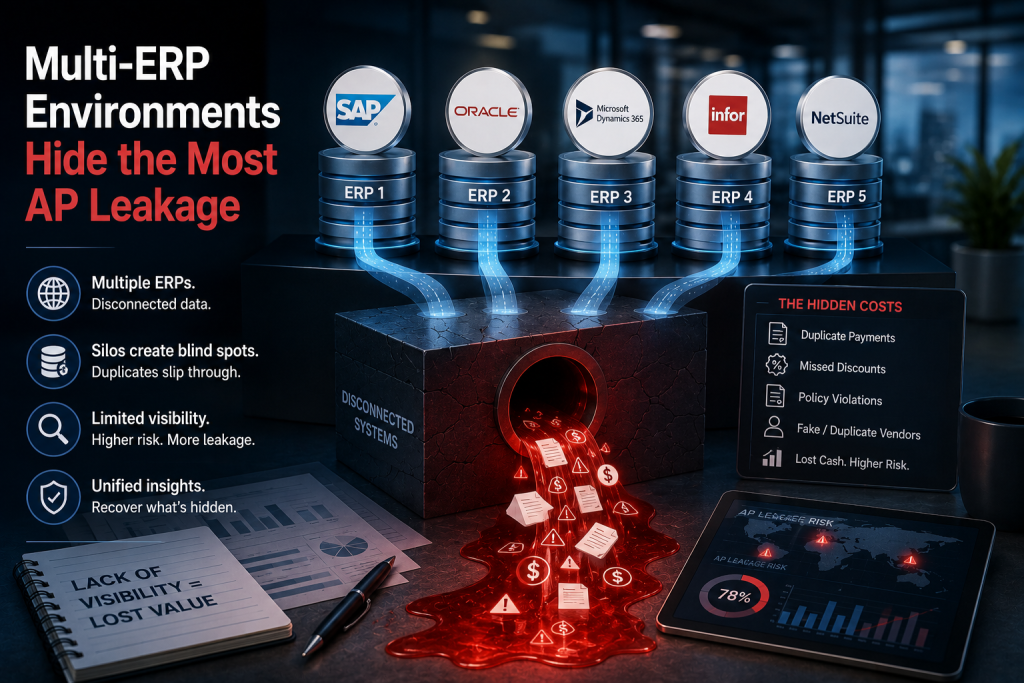
Most finance teams know their ERP has gaps. What they underestimate is how much worse those gaps become when you run two or three platforms simultaneously.
A company with SAP in North America, Oracle in Europe, and JD Edwards for a legacy division isn’t managing three separate systems. It’s managing nine failure modes at the points where data crosses borders, gets consolidated, or syncs through middleware.
The handoff problem
Single-ERP shops catch most duplicate payments eventually. Internal controls flag the same invoice number, vendor ID, or amount. The system won’t let you pay the same line twice without an override.
Multi-ERP environments break that logic. An invoice enters SAP in USD, gets converted and re-entered into Oracle in EUR, then appears in JDE after an acquisition closes. Three general ledgers, three sets of vendor master files, three payment runs. No single system sees all three.
The duplicate isn’t identical anymore. Different currency, different entity, different fiscal period. It looks like three legitimate payments because each ERP only sees one-third of the picture.
Where leakage concentrates
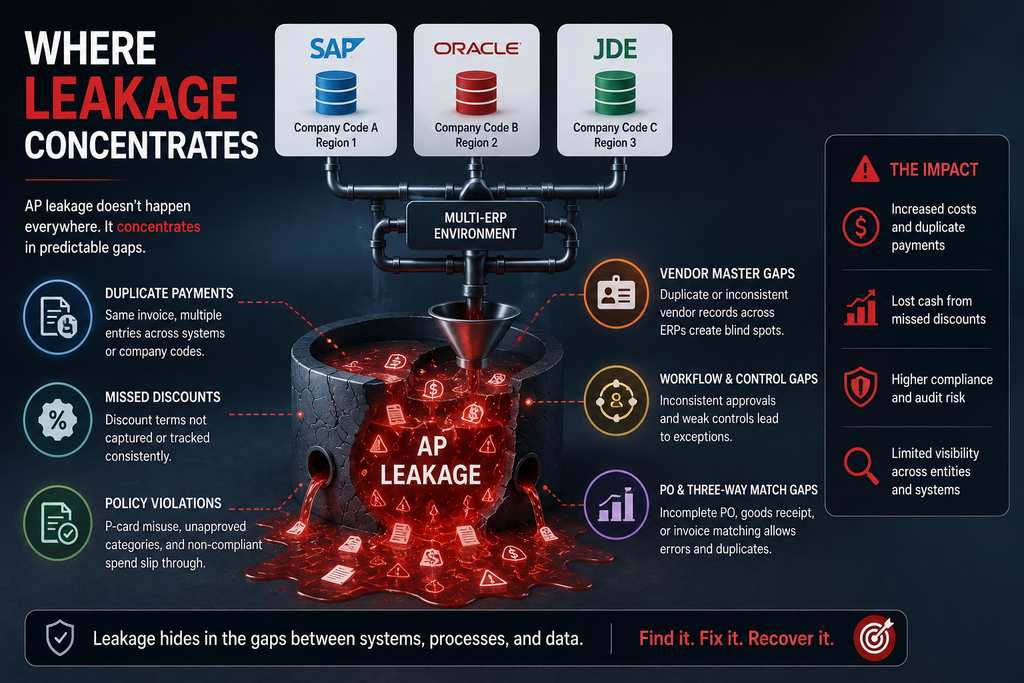
Handoff-driven leakage clusters in predictable places:
- Shared service centres that process invoices for multiple entities before routing them to the relevant ERP
- Vendor master files that don’t sync cleanly—same supplier, five different IDs across platforms
- Intercompany charges that post in one ERP, get invoiced externally, then re-enter through another system
- Credits issued in one platform that never offset invoices sitting in another
- Currency restatements that trigger re-entry instead of journal adjustment
Each point represents a process gap, not a software bug. The ERP is doing what it was told. The problem is nobody designed a process that works across all three.
Why internal audit misses it
Internal audit samples within each ERP. They test duplicate-payment controls inside SAP, inside Oracle, inside JDE. Those controls work fine.
What they don’t test is whether a payment made in SAP can duplicate a payment made in Oracle. That requires a cross-platform dataset, vendor normalisation, and fuzzy matching logic. Most audit teams don’t have the tools or the mandate.
The CFO sees three clean audits and assumes the risk is managed. It isn’t. The risk lives in the white space between the audits.
Consolidation creates a second wave
Even if payments don’t duplicate across ERPs during processing, consolidation introduces a second failure mode.
Finance pulls data from all three platforms into a reporting layer—Hyperion, SAC, sometimes just Excel. That layer is meant for reporting, not reconciliation. Vendor names don’t match. Entity hierarchies differ. Someone manually maps everything into a common chart of accounts.
Manual mapping creates manual error. An accrual gets doubled. A credit gets dropped. A payment made in one ERP offsets a liability that only exists in another, and the consolidation logic doesn’t connect them.
By the time the consolidated balance sheet is final, the underlying detail is three months old and locked. No one goes back to check whether AP in the reporting layer actually reconciles to the sum of AP across all three ERPs. They assume it does.
The integration tax
Some finance teams try to solve this by integrating their ERPs—middleware that syncs vendor masters, pushes invoices between systems, consolidates payment files. Integration helps, but it also creates new gaps.
Middleware introduces transformation rules. Vendor ID formats get standardised. Invoice numbers get prefixed. Amounts get rounded. Every transformation is a chance for a mismatch that silently breaks a downstream control.
You also inherit the middleware’s failure modes. If it goes down for two days, does the backlog get processed in order? Do invoices get queued or dropped? Does anyone notice?
Integration doesn’t eliminate the handoff problem. It moves the handoff into a layer that’s even harder to audit.
What this means for recovery
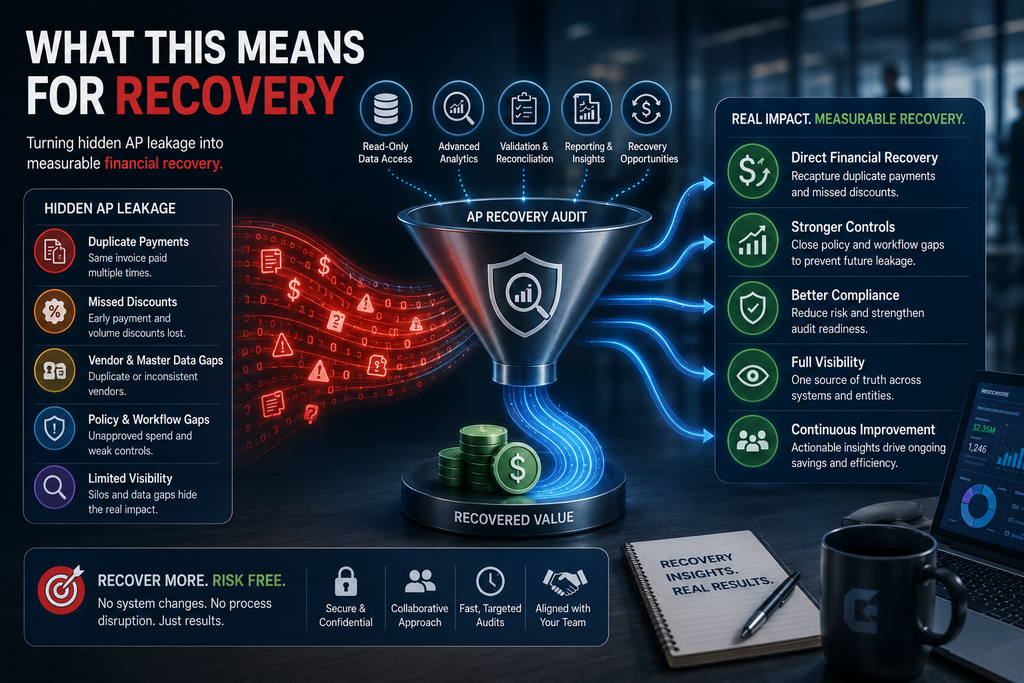
Multi-ERP environments don’t just hide more leakage—they make recovery harder.
A duplicate payment that spans two ERPs requires two offsetting entries to fix. That means two approvals, two posting periods, two sets of documentation. If the original payment was eighteen months ago, one of those ERPs might be closed for that fiscal year. Now you need a journal entry in one system and a manual offset in another, with a reconciliation item that lives forever.
Credits are worse. A credit issued in Oracle that should offset an overpayment in SAP requires someone to manually track the linkage. The systems won’t do it. If the offset never happens, the credit sits unused and the overpayment sits unrecovered.
This is why recovery work in multi-ERP environments skews toward low-complexity, high-value items. A $50,000 duplicate that lives entirely inside one ERP is faster to fix than a $10,000 mismatch that spans two.
Fixing the environment vs recovering the leakage
The long-term fix is process redesign—common vendor masters, centralised invoice processing, unified payment hubs. That takes years and costs millions.
In the meantime, the leakage is still there. Recovering it doesn’t require fixing the process. It requires someone who can work across all three platforms, normalise the data, and isolate the mismatches that internal teams don’t have time to chase.
If your AP function runs on multiple ERPs and you haven’t looked for cross-platform duplicates or orphaned credits in the last two years, the leakage is measurable. A contingency-based recovery sweep finds it without adding budget or headcount risk.