

Rebate programmes promise predictable savings. Volume commitments earn tiered credits. Early payments unlock percentage discounts. Contract compliance delivers year-end refunds. Then finance closes the quarter and the expected rebates never arrive. The supplier says thresholds weren’t met. The ERP shows invoice volume that should qualify. Somewhere in the transaction chain, the claim fell apart.
Rebate leakage doesn’t announce itself. No error message flags a missed discount. No workflow alerts when spend posts to the wrong contract. The system processes invoices, posts payments, and moves on. The lost savings sit silent in supplier reconciliations and unclaimed credit balances.
Volume rebates and the spend fragmentation problem
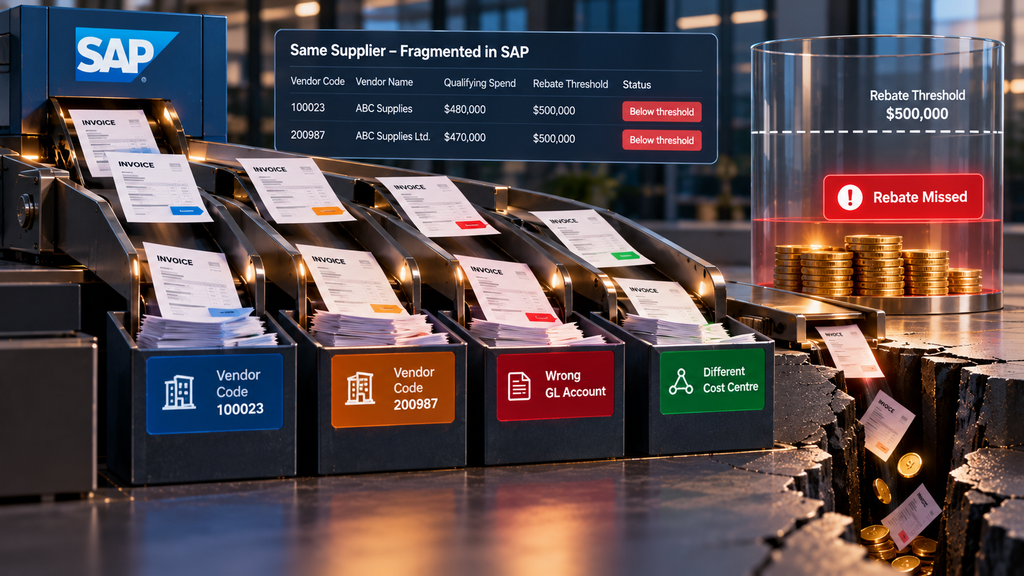
Volume rebates depend on one number: total qualifying spend with a supplier over a defined period. Reach the threshold, earn the rebate. Miss it by a single transaction, and the credit disappears. SAP calculates that total from invoice line items, purchase orders, and payment records. When those records scatter across mismatched codes, the total never materialises.
Duplicate vendor master records are the most common culprit. A supplier acquires another company. The acquiring entity inherits the legacy vendor code. New invoices arrive under a different name. Finance creates a second master record. Spend splits between two unrelated vendor numbers. Neither record crosses the rebate threshold on its own. The supplier’s books show combined volume well above the tier. Your ERP shows two separate relationships, both under the qualifying mark.
Invoice miscoding produces the same result. An invoice intended for a rebate-eligible contract posts to the wrong GL account or cost centre. The transaction exists in the system but falls outside the scope of rebate reporting queries. When finance runs the year-end rebate calculation, that spend doesn’t appear in the supplier total. The claim goes unfiled.
Off-contract purchasing compounds the issue. A business unit orders from an approved supplier through a non-standard requisition. The invoice bypasses the master agreement and posts without the contract reference field populated. The supplier counts it toward the rebate. SAP’s contract spend report doesn’t. The discrepancy surfaces months later during reconciliation, long after the rebate claim window closed.
Early payment discount failures
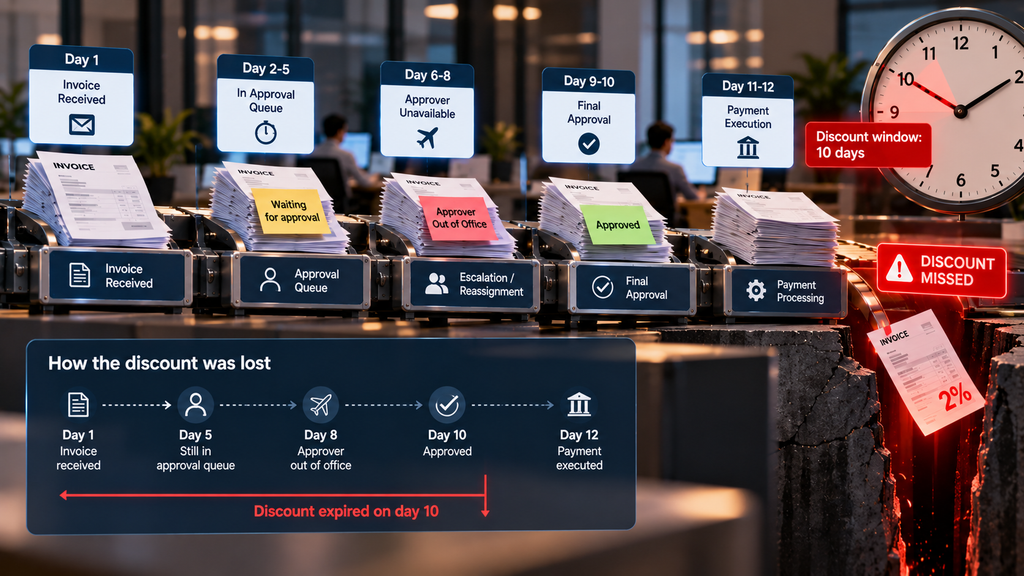
Early payment discounts live or die by timing. An invoice offers two per cent off if paid within ten days. The payment clears on day eleven. The discount vanishes. SAP workflows introduce multiple delay points between invoice receipt and payment execution. Each one can push the transaction past the discount deadline.
Invoice approval queues are the most visible delay. An invoice enters the system on day one. It sits in the approval queue for four days. The approver reviews and forwards it to the next level. That approver is out of office. The workflow stalls. By the time all approvals clear, eight days have passed. The payment run executes on day twelve. The discount expired on day ten. The system processed everything correctly. The timing made it worthless.
Payment run schedules also create gaps. Finance executes weekly payment batches every Thursday. An invoice with a ten-day discount term arrives on Friday. It clears approvals by the following Tuesday. The earliest payment run is Thursday—twelve days after invoice date. The discount window closed two days earlier. The payment goes out at full invoice value.
Discount term mismatches between purchase orders and invoices add another layer of failure. The PO specifies two per cent net ten. The invoice states two per cent net fourteen. SAP defaults to the PO terms for the discount calculation. The payment clears on day twelve. Finance expects the discount. The system flags it as late. The supplier’s terms allowed it. The purchase order didn’t. The discount is disputed and often written off rather than resolved.
Contract and pricing schedule mismatches
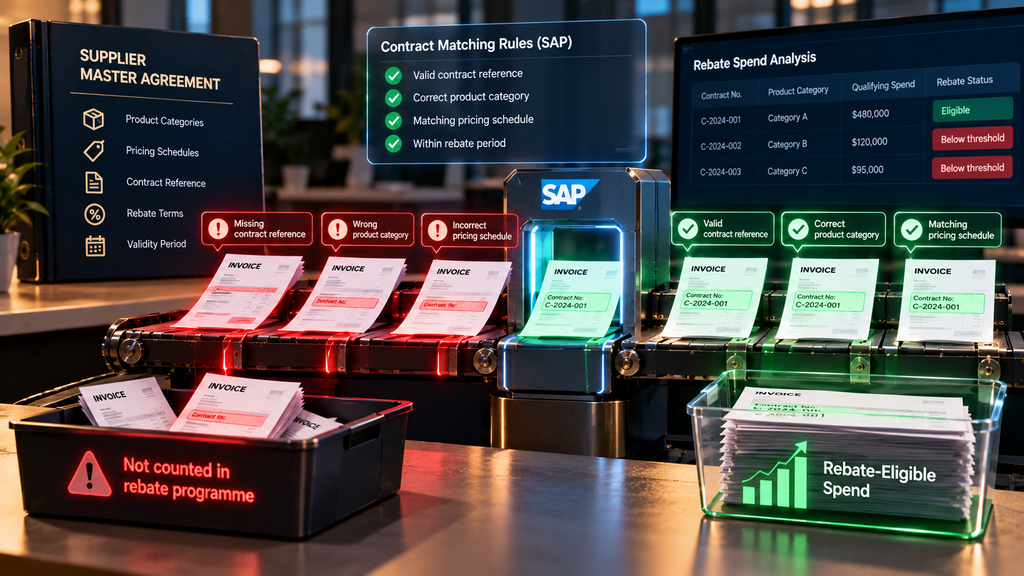
Rebates often tie to specific product categories, service lines, or pricing schedules outlined in master agreements. An invoice must link to the correct contract reference for the spend to count toward the rebate calculation. When that link breaks, the spend becomes invisible to the rebate programme.
Missing contract reference fields are the simplest version of this failure. A purchase order gets created without populating the contract number field. The invoice matches to that PO and inherits the blank reference. The invoice posts successfully. The contract spend report shows nothing. The rebate calculation misses that entire invoice. The supplier expects the volume to count. The system has no way to include it.
Incorrect cost centre or internal order assignments create similar invisibility. Rebate programmes sometimes limit qualifying spend to specific business units or projects. An invoice posts to the wrong cost centre due to a requisition error or default field setting. The spend falls outside the rebate scope definition. The reporting query excludes it. The contract volume total comes up short.
Pricing schedule versioning adds complexity. A supplier updates pricing mid-year and issues a new schedule. The rebate terms tie to the updated schedule. Some invoices continue to reference the old pricing version in their line item details. The system can’t reconcile which transactions fall under which rebate terms. Finance ends up manually sorting invoices to determine eligibility, introducing its own errors and delays.
What to look for
Most rebate failures leave traces in exception reports and reconciliation variances. Duplicate vendor records show up as near-identical names in master data extracts. Missed discounts appear when payment dates sit just outside discount terms across multiple invoices. Contract mismatches surface when finance rebate totals don’t align with supplier statements at quarter-end.
Quarterly rebate reconciliation catches these issues faster than annual reviews. Supplier statements arrive. Finance compares them against internal spend reports. Discrepancies get flagged and investigated while records are still accessible. Waiting until year-end means chasing down invoices and approvals from three quarters prior, often after key personnel have moved on.
Continuous monitoring eliminates the lag entirely. Automated checks flag invoices posting without contract references in real time. Duplicate vendor codes get identified during monthly master data reviews. Payment runs get analysed for discount capture rates immediately after execution. Problems get corrected in the current period instead of discovered months later.
Fintralis works across SAP, Oracle and JD Edwards environments on a 100% contingency model, identifying and recovering missed rebates, unclaimed discounts and duplicate payments. You pay only on what we recover. If you suspect your AP workflows are losing rebate value, we’ll show you where it’s going.
Frequently asked questions
Why do volume rebates get missed in SAP accounts payable?
Volume rebates require accurate spend accumulation against the right supplier and contract. Invoice miscoding, duplicate vendor master records, and off-contract purchases fragment spend totals. When totals don’t cross rebate thresholds in the system, claims never trigger and the money sits unclaimed with the supplier.
What causes early payment discount failures in SAP?
Discounts fail when payment runs occur after the discount deadline, invoice approval queues stall, or the discount terms in the PO don’t match the invoice. SAP workflow delays and manual approval bottlenecks push payments past the qualifying window. The discount opportunity expires before the payment posts.
How do contract mismatches create rebate loss?
Rebates tie to specific contract numbers or pricing schedules. When invoices post to the wrong cost centre, GL account, or contract reference, the system can’t link spend to rebate tiers. The supplier sees compliant volume; your ERP shows spend scattered across unrelated codes. Neither party can reconcile the claim.
Can duplicate vendor records hide rebate-eligible spend?
Yes. When the same supplier exists under multiple vendor codes due to acquisitions, regional setups, or data entry errors, spend splits across unrelated master records. Rebate calculations run per vendor code. A supplier owed a rebate on combined spend sees fragmented totals and withholds the credit.
What role does invoice coding accuracy play in rebate recovery?
Rebate calculations depend on transactions tagged to the right category, contract, or product line. Miscoded invoices—wrong GL, cost centre, or material group—fall outside rebate scope in reporting queries. The spend happened, but the system can’t prove it qualifies. The supplier rejects the claim.
How often should finance teams audit for missed rebates?
Quarterly reviews catch most issues before rebate windows close. Annual audits recover older claims but face supplier record-retention limits. Continuous monitoring flags invoice coding errors and contract mismatches in real time, stopping leakage before it accumulates into material amounts.