
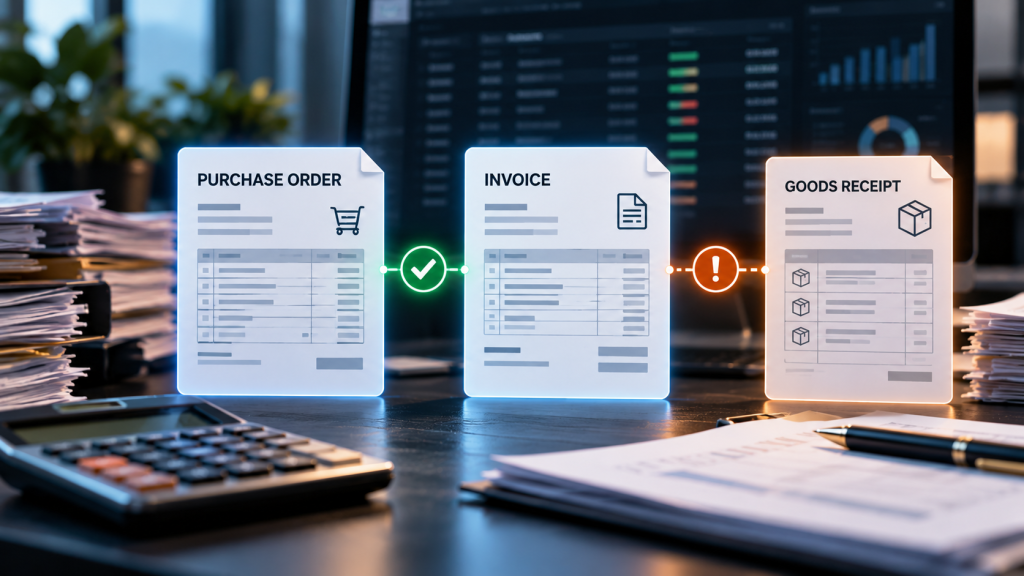
Two-way matching compares an invoice to the purchase order. If they agree within tolerance, the system approves payment. This catches some errors and misses others. Understanding which is which keeps you from paying for problems your ERP thinks are fine.
What two-way matching verifies
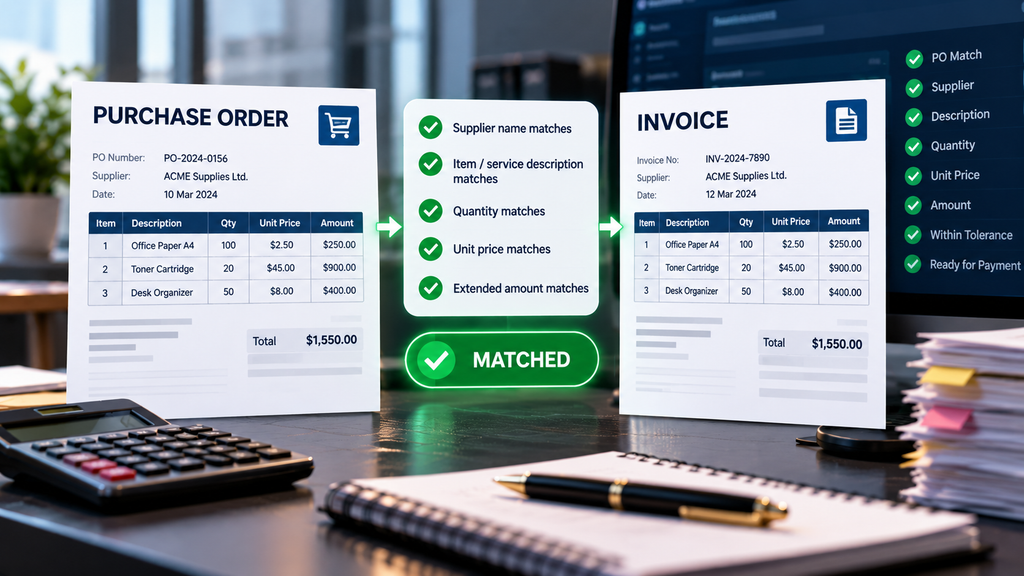
A two-way match checks the invoice against the PO for supplier name, item or service description, unit price, quantity ordered and extended amount. If the invoice total falls within your tolerance threshold—commonly 5% or a fixed dollar amount—the system flags it as matched and moves it toward payment.
This catches invoices for goods you never ordered. It stops payment to suppliers not on the PO. It blocks invoices with incorrect pricing or miscalculated line extensions. It prevents duplicate invoices from matching the same PO twice, assuming your ERP tracks PO utilisation properly.
Two-way matching works when the primary risk is paying for something you did not buy or paying the wrong amount for what you did buy. It relies entirely on the accuracy of the purchase order and the invoice. It assumes both documents describe the transaction correctly.
What two-way matching does not verify
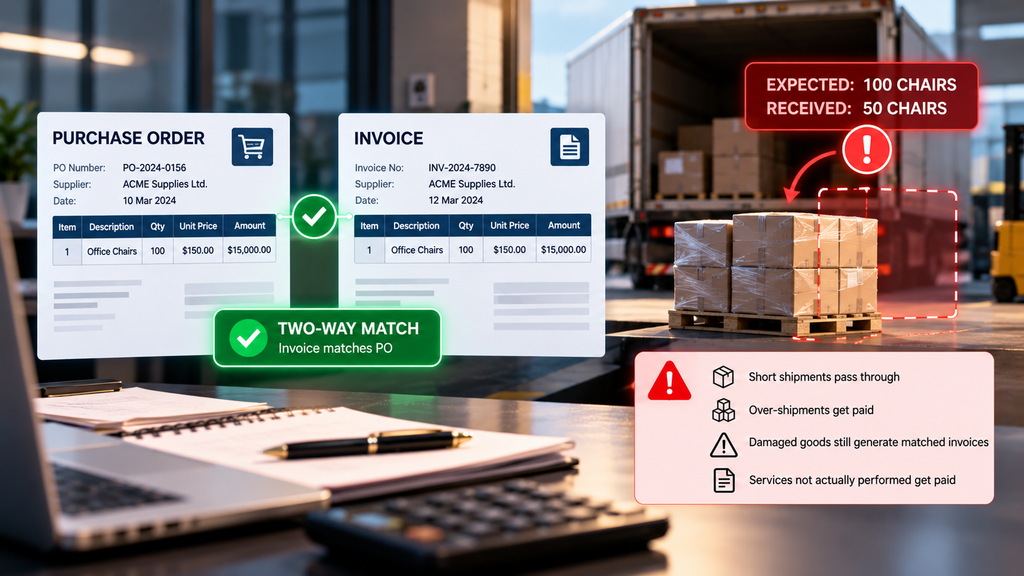
Two-way matching does not confirm you received the goods or services. It compares two pieces of paper. If the invoice matches the PO but the supplier only delivered half the order, two-way matching approves payment for the full amount.
This is the gap. Short shipments pass through. Over-shipments that were invoiced per the PO but not authorised get paid. Damaged goods rejected at the loading dock still generate matched invoices. Services billed at contract rates but not actually performed sail through because the invoice matches the statement of work.
Two-way matching also misses pricing that changed after the PO was issued. If your buyer negotiated a lower price but never updated the PO, the invoice matches the old price and you pay more than you should. If a rebate applies but the invoice was not adjusted, the match succeeds and you lose the rebate.
Purchase price variance only becomes visible when you add the goods receipt. Without that third document, two-way matching has no way to detect the gap between what you ordered and what actually arrived.
When two-way is sufficient
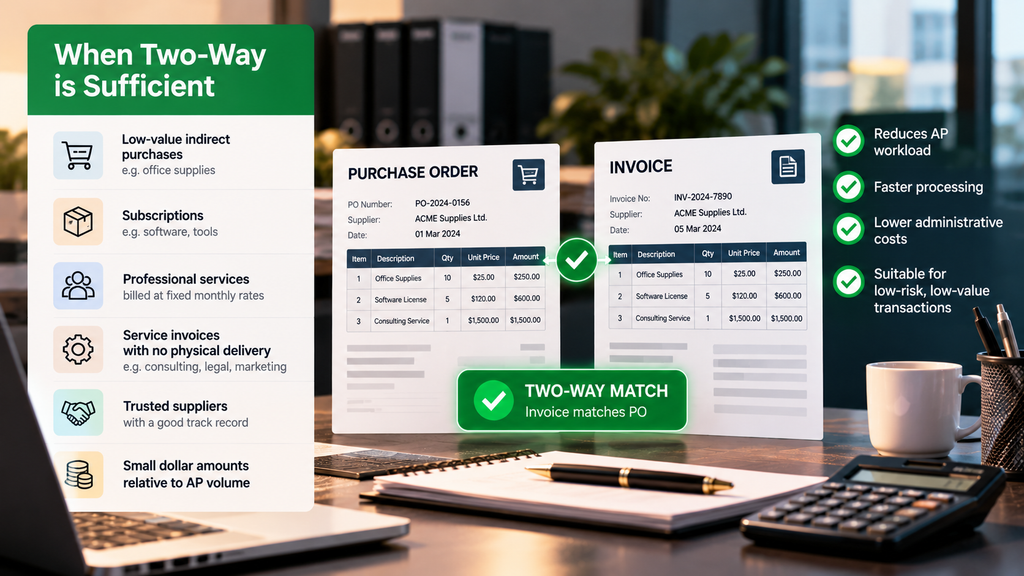
For low-value indirect purchases, two-way matching is often enough. The administrative cost of recording every goods receipt exceeds the risk of paying for something you did not get. Office supplies, subscriptions, professional services billed at fixed monthly rates—these are candidates for two-way processing.
Service invoices with no physical delivery also work on two-way matching, provided the service description is clear and disputes are managed outside the invoice-matching process. If you trust the supplier and the dollar amount is small relative to your AP volume, two-way matching reduces workload without materially increasing risk.
Two-way matching is also appropriate when receiving documentation is impractical. Some industries and some transaction types do not generate reliable goods receipts. In those cases, two-way is the best you can do within the ERP workflow.
When you need three-way matching
High-value inventory, direct materials, capital equipment and anything where quantity or quality variance matters financially should use three-way matching. The third document is the goods receipt, which confirms what actually arrived at your facility and was accepted by your receiving team.
Three-way matching compares invoice, PO and goods receipt. If the invoice claims you received 1,000 units but the receipt shows 950, the system blocks payment or reduces the approved amount. If the goods were rejected due to damage or non-conformance, the receipt reflects that and the invoice does not match.
This is where you prevent paying for phantom inventory, short shipments and quality failures. It is also where you catch clerical errors in receiving that would otherwise cost you money—receiving clerks who enter the invoice quantity instead of the actual count, for example.
Three-way matching requires process discipline. Receiving must log goods promptly and accurately. The goods receipt must reference the correct PO. Your ERP must be configured to enforce the three-way rule for the relevant GL accounts or material groups. Without that discipline, three-way matching becomes a data-entry burden that does not improve control.
Where overpayments still occur
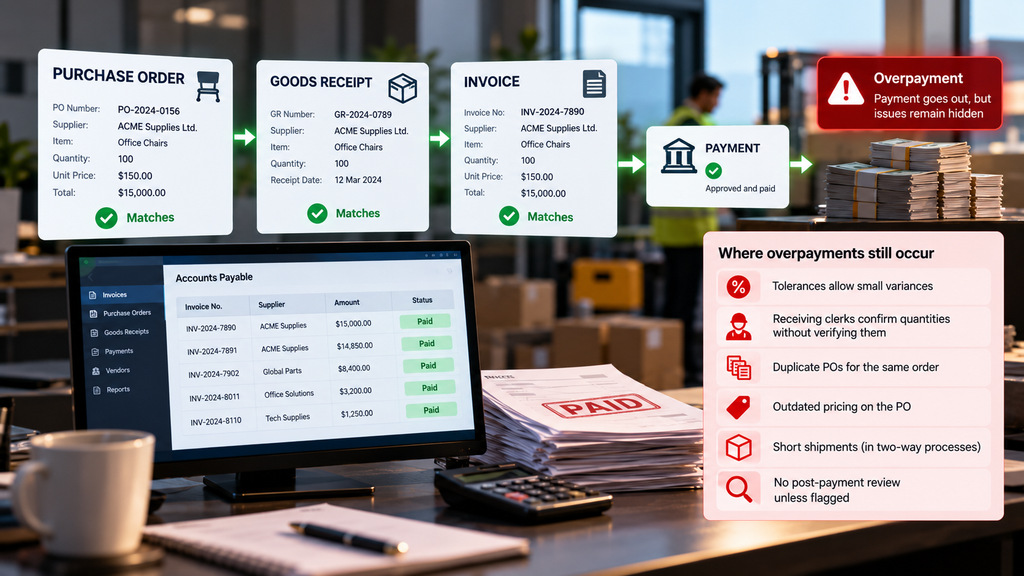
Even with three-way matching in place, errors slip through. Tolerances allow small variances. Receiving clerks sometimes confirm quantities without verifying them. Duplicate POs for the same order create multiple payment opportunities. Pricing on the PO is outdated but the goods receipt matches the quantity, so the inflated invoice is approved.
Two-way matched invoices are not reviewed after payment unless someone has reason to question them. If your process is two-way and your supplier ships short, you have no automated control to catch it. The invoice matched, payment went out, and the discrepancy sits in your records until someone notices physical inventory does not reconcile.
Recovery work involves comparing invoices to all available transaction records—not just POs, but also contracts, goods receipts, shipment logs and payment history. Two-way matched invoices often contain errors that matching logic was never designed to detect.
Deciding which match level to use
Set match requirements by materiality and risk, not by convenience. If a category of spend has low transaction values and reliable suppliers, two-way matching reduces administrative cost without meaningful control loss. If the spend involves physical goods with variable quality or quantity, three-way matching is worth the effort.
Audit your tolerances. A 5% band on high-dollar POs allows large overpayments to auto-approve. Tighten tolerances where the risk justifies it. Expand them where manual review costs more than the exposure.
Two-way matching is not weaker than three-way; it is appropriate for different risks. The mistake is using two-way matching for transaction types where receiving confirmation is both feasible and material, then assuming your AP process is airtight because everything matched.
If you run two-way matching on a significant portion of your AP spend, periodic recovery review will surface the invoices that matched but should not have been paid in full. That is where Fintralis operates—finding the gaps that matching logic cannot see and recovering money already out the door.
Frequently asked questions
What is two-way matching in accounts payable?
Two-way matching compares an invoice to the original purchase order to verify the supplier name, item descriptions, unit prices and total amount before payment is approved. If the invoice matches the PO within tolerance thresholds, the system allows payment to proceed without additional verification steps.
What errors does two-way matching catch?
Two-way matching detects invoices for goods never ordered, invoices from unauthorised suppliers, incorrect unit prices, miscalculated line totals and duplicate invoices already matched to the same PO. It stops payment when the invoice contains items or amounts that do not appear on the corresponding purchase order.
What errors does two-way matching miss?
Two-way matching does not verify quantities received, so it misses short shipments, over-shipments, damaged goods and items rejected at receiving. It also cannot detect quality issues, service performance disputes or changes to scope that invalidate the original PO pricing.
When is two-way matching sufficient for AP controls?
Two-way matching is sufficient when ordering indirect materials with reliable suppliers, purchasing professional services billed at fixed rates, or processing low-value transactions where the cost of three-way verification exceeds the risk. It works when receiving confirmation is impractical or administratively expensive relative to transaction value.
When should you use three-way matching instead of two-way?
Three-way matching is necessary for high-value inventory purchases, direct materials, capital equipment and any goods where quantity or quality variance creates material financial exposure. If your business depends on physical goods arriving as ordered, three-way matching protects against paying for items you did not actually receive.
Can AP recovery services find overpayments in two-way matched invoices?
Yes. Recovery services compare invoices to receiving records, contracts and shipment data that two-way matching does not verify. They identify payments for undelivered quantities, duplicate POs, pricing errors within tolerance bands and invoices matched to outdated or superseded purchase orders that AP systems approved as valid.