

Every major ERP generates duplicate payments, but SAP, Oracle and JD Edwards each do it in recognisably different ways. The platform you run shapes where duplicates hide, which reports surface them, and how quickly you can recover cash once you find them.
Understanding the structural differences matters because a recovery audit that works well in SAP will miss entire categories of overpayment in Oracle, and vice versa. Finance teams that treat all ERPs the same leave money on the table.
SAP: Payment Runs and Vendor-Master Proliferation
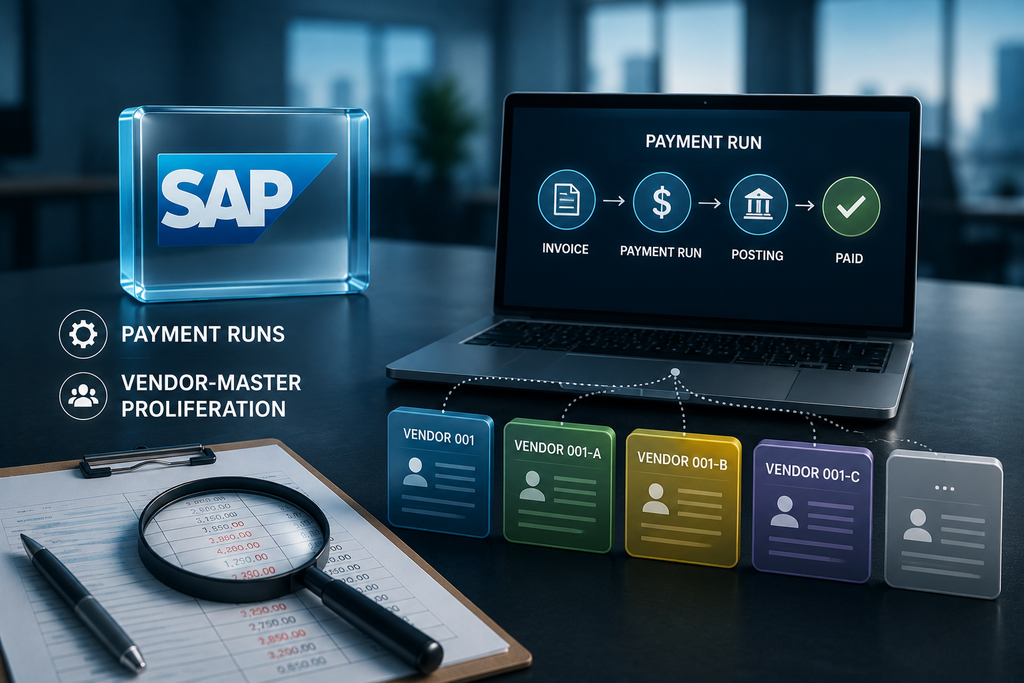
SAP’s automatic payment program—transaction F110—is powerful and unforgiving. Duplicates most often arise when invoice and credit-memo timing misalign, when a single economic supplier appears in the vendor master under multiple account numbers, or when payment methods and house banks are configured inconsistently.
A common pattern: an invoice posts, the payment program selects it, then a credit memo arrives and posts after the payment proposal locks but before the payment run executes. The system pays the original invoice in full, and the credit sits as an open item, sometimes indefinitely. If the supplier later invoices again, the credit applies—but you have already paid once more than you owed.
Vendor-master duplication is endemic in SAP. Decentralised procurement, legacy migrations and acquisition integrations create multiple vendor codes for one supplier. Each code can carry its own payment terms, dunning settings and bank details. The payment program treats them as independent, so the same invoice amount, reference and date can be paid twice to different remittance addresses that ultimately reach the same bank account.
SAP’s three-way match—goods receipt, invoice receipt, purchase order—works well when everyone follows it. Manual invoice entry through FB60 or park-and-post workflows bypass those controls. High-volume environments with tight close deadlines often shortcut the full match, and duplicates follow.
Oracle: Batch Import and Payment-Batch Matching
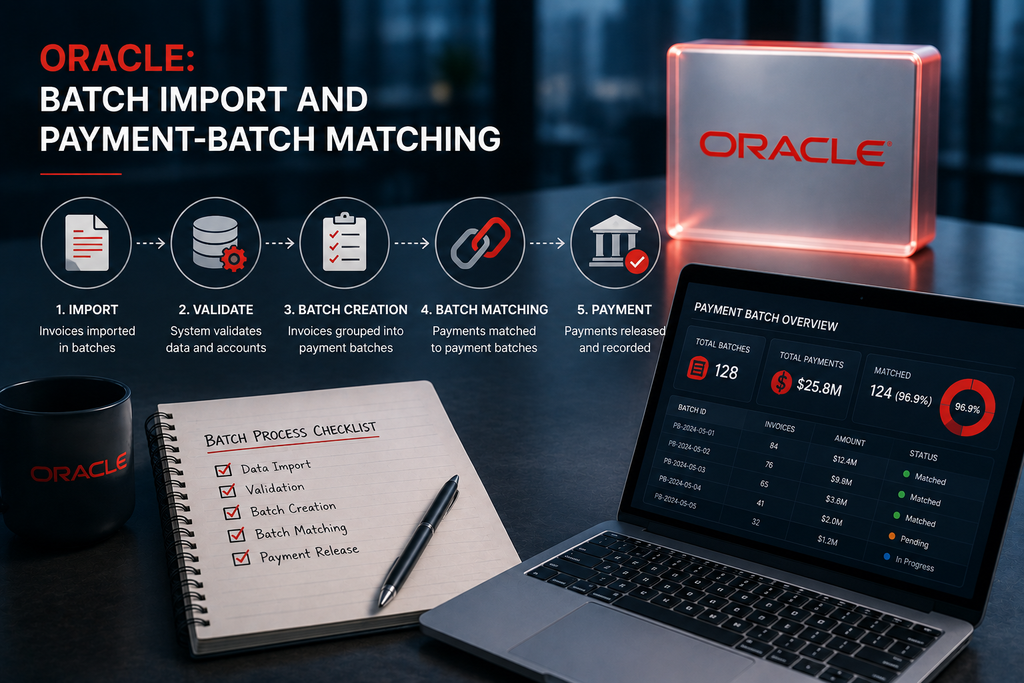
Oracle ERP and Oracle Cloud route most invoices through automatic import interfaces—EDI feeds, OCR capture, supplier portals. Duplicates cluster at the import stage: the same invoice file processed twice, EDI retransmissions treated as new documents, or invoice images matched to the wrong purchase order and then re-entered manually when the discrepancy surfaces.
Oracle’s invoice-approval workflow can mask duplicates because approvers see summary data, not full line-item history. If an invoice is rejected, corrected and resubmitted, the original often remains in the system as cancelled or unapproved, but a payment-batch query may pull both records if status filters are not precise.
Payment batches in Oracle allow grouping by supplier, site, payment method and currency. A single supplier with multiple sites—each representing a different ship-to or bill-to location—can receive separate payments for the same invoice if site assignment is inconsistent between purchase order, receipt and invoice. The system sees different supplier-site combinations as distinct payees.
Oracle’s “pay on receipt” auto-invoice process creates payment risk when goods-receipt tolerances are wide and invoice matching is loose. A receipt triggers payment, then a later invoice for the same receipt posts and pays again, especially in environments where receiving and invoicing happen in different modules or business units with weak reconciliation.
JD Edwards: Voucher Matching and Address-Book Sprawl
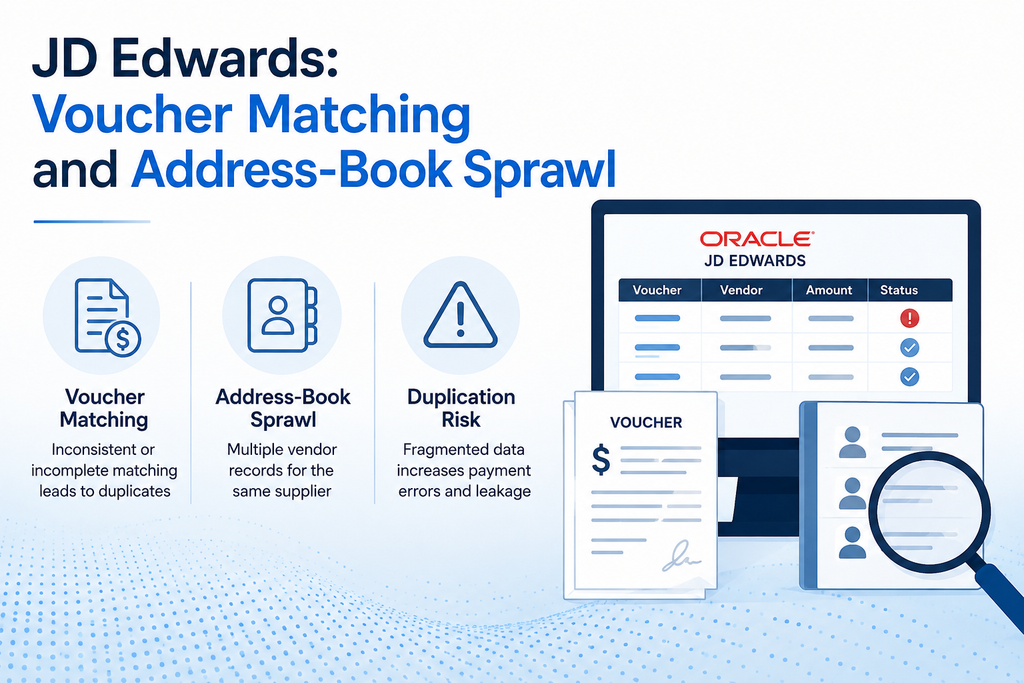
JD Edwards handles procurement through vouchers—essentially internal representations of supplier invoices. Voucher matching relies on tolerance settings: quantity variance, price variance, and amount thresholds. Duplicates happen when tolerances are set wide to reduce exception queues, allowing two vouchers for the same invoice to clear matching if amounts differ slightly due to freight, tax or currency rounding.
Manual voucher entry in JDE is common, particularly for non-PO invoices—utilities, rent, professional services. There is no electronic duplicate check at entry time; the system relies on the AP clerk to search existing vouchers before creating a new one. Under deadline pressure or with insufficient training, the same invoice posts twice, weeks or months apart, and both pay.
JD Edwards’ address book is notoriously prone to duplicate records. Each supplier can have multiple address-book numbers, sometimes intentionally—different divisions, different tax jurisdictions—but often accidentally, from typos, format inconsistencies or legacy data conversions. The payment process treats each address-book number as a separate entity, so the same invoice can be paid to two address-book numbers that represent one supplier.
Automatic payment selection in JDE uses pay-status codes and payment instruments. If a voucher’s pay status updates incorrectly—due to a failed payment file, a bank rejection, or a manual status change without a corresponding payment reversal—the voucher can be selected and paid again in a later payment cycle.
Common Ground Across All Three
Despite architectural differences, certain duplicate patterns appear in every platform. Credit memos issued after payment consistently create risk: the system pays the gross invoice, the supplier applies the credit to their next invoice, and you pay that next invoice in full, never recovering the original overpayment unless someone manually reconciles supplier statements.
High-volume suppliers with hundreds of monthly invoices are statistically more likely to produce duplicates simply because the transaction count is high and matching errors compound. Suppliers who invoice both against purchase orders and on open account create dual pathways in the ERP, increasing the chance that the same economic transaction posts twice through different workflows.
Process drift over time defeats even good controls. An ERP configured correctly at go-live develops exceptions, workarounds and “temporary” process changes that become permanent. Tolerances widen, approval steps get skipped, and manual overrides accumulate, all of which increase duplicate risk regardless of platform.
What This Means for Recovery
A rigorous duplicate-payment audit must be platform-specific in its data extraction and analysis. The SQL queries, table joins and status-field logic that identify duplicates in SAP’s BSAK and BSIK tables do not translate directly to Oracle’s AP_INVOICES or JDE’s F0411 voucher file. Each platform stores payment history, supplier linkage and matching status differently.
Recovery velocity also varies by platform. SAP environments with tightly controlled vendor masters and centralised payment operations can reverse and reclaim duplicates faster because fewer stakeholders need to approve the correction. Oracle and JDE implementations with decentralised AP teams and site-level autonomy require more coordination, which slows recovery even when the duplicate is undisputed.
If your AP spend exceeds $50 million annually and you run SAP, Oracle or JD Edwards, a systematic payment audit will find overpayments. The patterns differ, but the financial impact does not. Fintralis works on contingency across all three platforms, which means you recover cash with no upfront cost and no drain on your team’s time.
Frequently asked questions
Which ERP system has the most duplicate payment problems?
No ERP is inherently worse; each platform produces duplicates in different ways. SAP duplicates often trace to posting-key and dunning configurations. Oracle duplicates cluster around invoice-import batches and payment-batch matching. JDE duplicates frequently involve voucher-matching rules and address-book entries. Volume matters more than platform.
How do duplicate payments happen differently in SAP versus Oracle?
SAP duplicates commonly arise from payment-run parameters, vendor-master records with multiple payment addresses, and credit-memo handling. Oracle duplicates typically come from invoice-import automation, payment-batch processing, and supplier-site setup. The workflow timing differs: SAP issues tend to surface at payment-program execution; Oracle issues often appear during invoice entry or approval.
What causes duplicate payments in JD Edwards?
JDE duplicates frequently stem from voucher-matching tolerance settings, pay-item rules, and address-book number proliferation. Manual voucher entry bypasses three-way match controls, and automatic payment selection can pull the same liability twice if voucher status or pay-status codes are inconsistent. Address-book duplicates create separate payment destinations for one economic supplier.
Can ERP systems prevent duplicate payments automatically?
Modern ERP releases include some duplicate-detection logic—invoice-number matching, amount and date tolerances, supplier cross-checks—but configuration gaps, data-quality issues, and process workarounds routinely defeat these controls. No platform catches everything automatically, which is why post-payment recovery audits consistently find overpayments across all three major systems.
Where should finance teams look first for duplicate payments?
Start with high-volume suppliers, invoices paid outside purchase-order matching, credit memos applied after payment, and any supplier with multiple remit-to addresses in your vendor master. Each ERP platform tags these scenarios differently, but the economic pattern is the same: partial visibility during approval and settlement timing mismatches.
How far back should a duplicate-payment audit go?
Most jurisdictions allow commercial claims for three to six years, so a forensic audit typically reviews 36 to 72 months of payment history. Older duplicates are harder to recover—supplier records age out, contacts turn over, systems archive—but the highest-value findings often sit in year two or three, after process drift accumulates but before anyone notices.