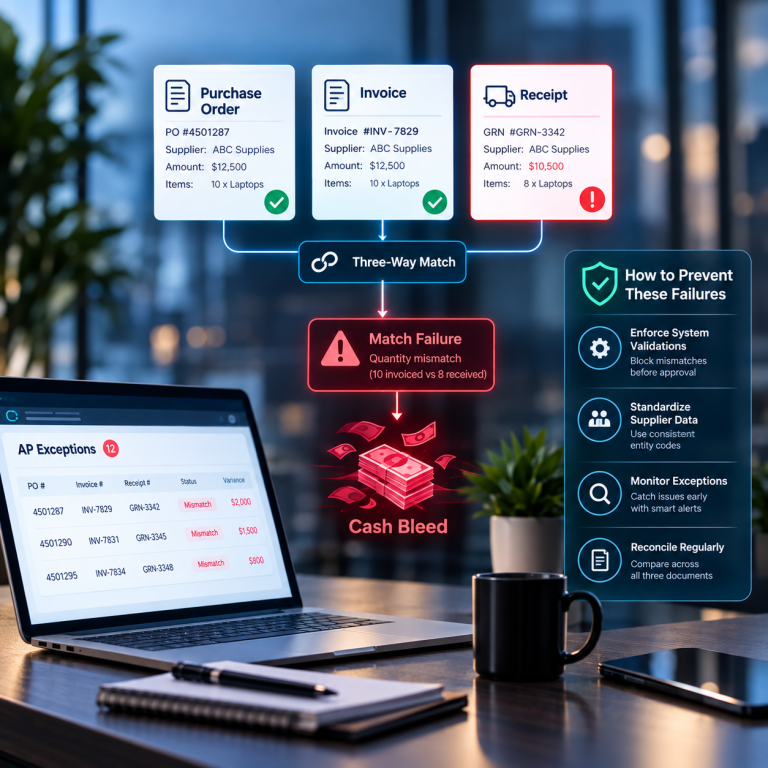

Finance leaders who manage $50M or more in annual accounts payable spend operate in an environment where process exceptions are common. Invoice timing issues, supplier consolidation, ERP data migrations, and decentralized procurement all create opportunities for the same obligation to be paid more than once or for incorrect amounts to go unnoticed.
The question is not whether leakage exists. It does. The question is how much sits in your transaction history and whether the effort to recover it justifies the cost.
Where AP Leakage Comes From
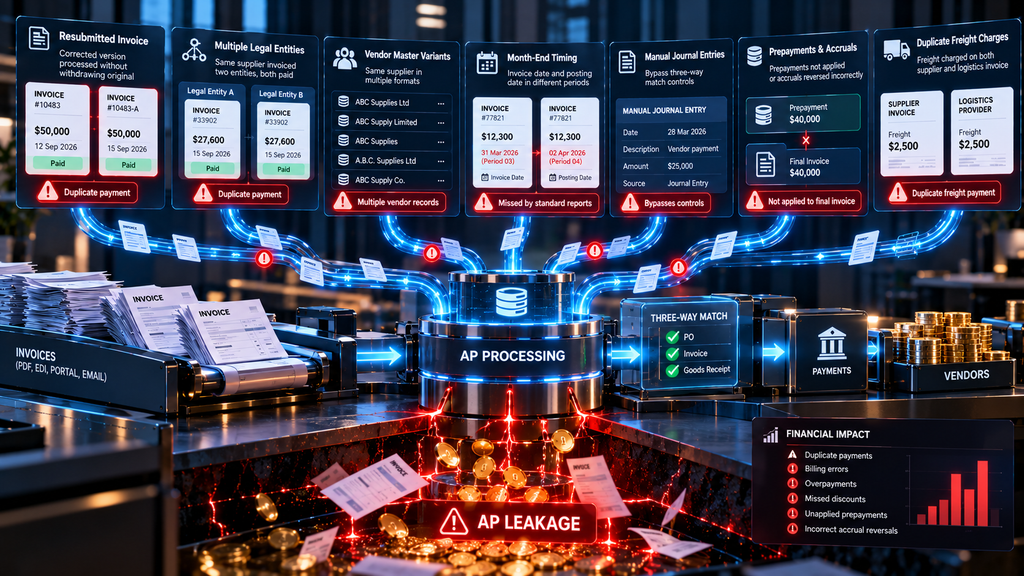
Duplicate payments happen when controls designed to catch them fail. A supplier submits an invoice, then resubmits a corrected version without withdrawing the original. Your AP team processes both. Or the same supplier invoices two legal entities within your ERP structure for a shared service, and both entities pay.
Invoice reference numbers change between submission and resubmission. Supplier names appear in multiple formats depending on who entered the vendor master record. Timing differences mean an invoice dated in one accounting period gets posted in another, so standard duplicate-detection reports miss it.
Manual journal entries, common during month-end close, bypass the standard three-way match process entirely. Accruals get reversed incorrectly. Prepayments are not applied against final invoices. Freight charges appear on both the supplier invoice and the logistics provider invoice.
Billing errors differ from duplicates but have the same effect. A supplier applies the wrong contract rate. They invoice for a cancelled order. They charge for a full pallet when a partial was delivered. They bill weekly instead of monthly and no one aggregates the charges to confirm the total.
In multi-entity ERP environments, the problem multiplies. Shared service suppliers bill each legal entity separately. Intercompany charges get duplicated. Regional procurement teams negotiate different rates for the same service and no one reconciles across entities.
Why Standard Controls Don’t Catch Everything

SAP, Oracle, and JD Edwards all include duplicate-payment controls. Those controls work when invoices arrive in predictable formats with consistent reference numbers and matching purchase orders. They fail when exceptions outnumber standard transactions.
Purchase orders exist for roughly 60% to 70% of invoices in most organizations. The remainder are non-PO invoices: utility bills, professional services, lease payments, subscriptions, and ad hoc purchases. Controls built around PO matching don’t apply.
Supplier master data degrades over time. Acquisitions add new vendor records without consolidating old ones. Name changes are not updated globally. The same supplier exists under five variants, and your duplicate-detection logic only matches exact names.
Timing creates gaps. An invoice submitted near month-end may not post until the following period. If a duplicate arrives and posts in the same period as the original was dated, it appears legitimate because the system sees no prior payment in the current window.
High invoice volumes make manual review impractical. A company processing 50,000 invoices a year cannot manually inspect every transaction. Controls rely on sampling, and samples miss outliers.
What a Recovery Audit Finds
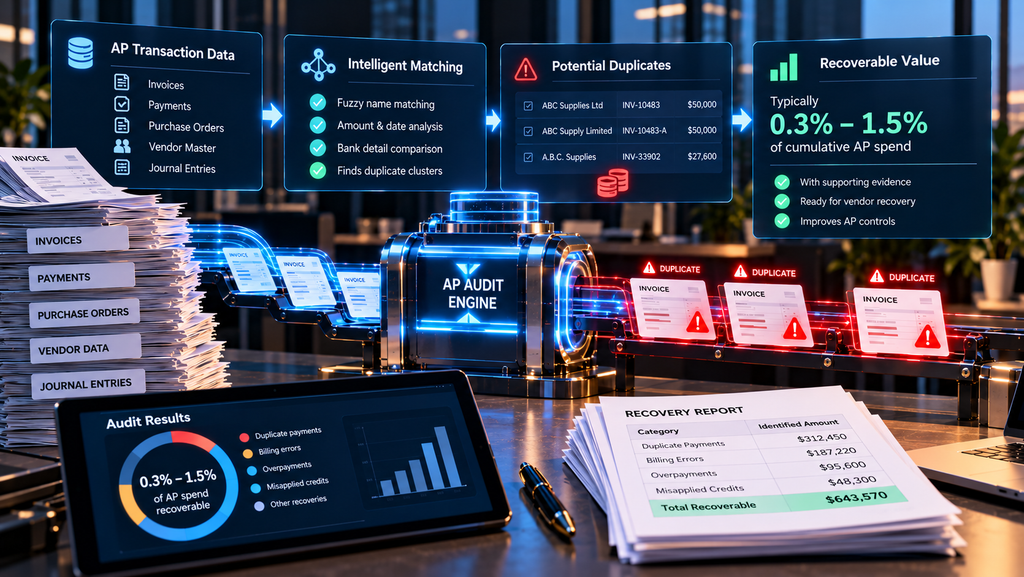
A systematic review of three to five years of AP transaction data typically identifies recoverable amounts equal to between 0.3% and 1.5% of cumulative spend. The range depends on invoice volume, supplier diversity, and ERP complexity.
Organizations with decentralized procurement or recent system migrations tend toward the higher end. Companies with mature AP automation and strong vendor master data governance trend lower.
The mechanics involve matching payments to supplier records using fuzzy logic that accounts for name variants, then comparing invoice amounts, dates, and bank details to identify pairs or clusters that represent the same obligation paid multiple times.
Recovered amounts are credited by the supplier, not charged back. The process involves presenting documentation to the supplier’s AP team and requesting a credit memo or refund check. Most suppliers have standard procedures for this and resolve claims within 30 to 90 days.
When to Pursue Recovery
The decision to audit AP history depends on whether the potential recovery exceeds the effort required to collect it. For companies with $50M+ in annual spend, a conservative estimate of 0.3% over three years suggests $450,000 in potential recovery.
If the audit and recovery work is performed on contingency, there is no upfront cost and no cost if nothing is found. The service provider takes a percentage of what they recover, and you retain the majority.
The alternative is to assume your controls caught everything, or to believe the effort is not worth the return. Both assumptions are testable. A limited-scope review of one year of data across a subset of high-volume suppliers provides a directional answer without committing to a full audit.
For finance teams managing cost reduction targets or working to improve cash flow, recovered AP spend provides a one-time benefit that requires no reduction in service levels or supplier relationships.
Fintralis delivers contingency-based AP recovery audits for organizations running SAP, Oracle, or JD Edwards. We identify duplicate payments and billing errors across your transaction history and manage the supplier recovery process from claim to credit. You get the cash with no upfront cost or internal effort.
Frequently asked questions
What percentage of AP spend is typically lost to duplicate payments?
Most organizations lose between 0.3% and 1.5% of their annual accounts payable spend to duplicate payments, billing errors, and unclaimed credits. The rate depends on invoice volume, supplier consolidation, and ERP controls. Companies with decentralized procurement or recent system migrations trend toward the higher end.
Why do duplicate payments happen in SAP or Oracle?
Duplicate payments occur when the same invoice appears under different reference numbers, when manual journal entries bypass standard controls, when suppliers submit corrected invoices without withdrawing the original, or when invoice timing crosses month-end close periods. Multi-entity ERP environments compound the risk because the same supplier may bill different legal entities simultaneously.
How do you find duplicate payments after they’ve been made?
Recovery firms match payment records against invoice data using supplier name variants, invoice amounts, payment dates, and bank details. They cross-reference purchase orders where available and flag payments that share characteristics with known duplicates. The process requires access to several years of transactional data across all company codes.
Can you recover duplicate payments made years ago?
Most suppliers will honor valid recovery claims on payments made within the past three to five years, though willingness decreases with time. The practical limit is usually the point at which supplier accounting records are archived or destroyed. Claims older than six years rarely succeed unless the amounts are substantial.
What’s the difference between a duplicate payment and a billing error?
A duplicate payment means your organization paid the same invoice twice or paid two invoices for identical goods or services. A billing error means the supplier charged an incorrect amount, applied the wrong contract rate, or invoiced for services not rendered. Both result in uncollected funds but require different evidence to support a recovery claim.
Do AP recovery audits disrupt supplier relationships?
Legitimate recovery claims rarely damage supplier relationships because the approach is transactional rather than adversarial. Suppliers expect occasional billing corrections and typically have standard credit processes for resolving disputes. The risk of relationship damage comes from aggressive claim language or failure to provide supporting documentation, not from the claim itself.